
In partnership with

TUE · NOV 17, 2026Superintelligence.ROBOTICS
TUE · NOV 17, 2026ROBOTICS
 
TODAY’S LEAD
Plot twist: US says NVIDIA cut off the suspect chip buyer last year
The US government says NVIDIA stopped selling to Megaspeed in June 2025, a month after investigators asked.
READ THE LEAD STORY →
Coolcaesar/Wikimedia Commons, CC BY-SA 4.0
By Kim IsenbergForwarded? Subscribe free →

The Signal · From the editor · Kim Isenberg
Today's two biggest stories are about oversight: who checks the companies that build AI, and how.
$5B
Isomorphic raised to take AI-designed drugs into human trials
$8.2B
AMD's all-stock deal for Fei-Fei Li's World Labs
825M
Anthropic IPO shares, with demand far above that
In Washington, the Commerce and Justice departments released a statement on Megaspeed. It says NVIDIA stopped selling to the Singapore company in June 2025. NVIDIA's board then set up a new export-control committee. At OpenAI, four outside groups now get access to unreleased models, training data and source code to check the company's safety work. One of them is Goodfire, a startup whose tools read what happens inside a model, and OpenAI explored buying it for more than $5 billion this summer. Elsewhere, Isomorphic Labs says its AI-designed drugs are working in early tests and raised $5 billion to take them into human trials, and a robot in San Francisco is taking cues from living human brain cells. Tonight, NVIDIA reports its first quarter under interim CEO Colette Kress.
All the best,Kim Isenberg signatureKim Isenberg
01  ·  IN THE NEWS
SECURITY  ·  Goodfire
OpenAI explored buying its new AI safety inspector
The Information reports that a senior OpenAI executive floated buying Goodfire for more than $5 billion. Image: Source: The Information, "OpenAI Explored $5 Billion–Plus Acquisition of Startup That Decodes How AI 'Thinks'", 11/16/2026; highlight added
→
IN SHORT
OpenAI wanted to own a company that can look inside its models; now it pays that company to inspect them.
A senior OpenAI executive floated buying Goodfire, a startup that reads what happens inside AI models, for more than $5 billion, The Information reports. The idea came up this summer. In July, a group of OpenAI's own AI models had secretly worked together and hacked several companies, including Hugging Face, and OpenAI was trying to understand why. In the end, OpenAI did not buy Goodfire. Goodfire was valued at $1.25 billion in February, and its executives reportedly think it is worth more on its own. On Monday, OpenAI named Goodfire one of four outside groups, alongside Apollo Research, METR and Transluce, that get deep access to its internal models to check its safety work. OpenAI discloses that Goodfire is paid for this, though not based on its findings.
READ AT THE INFORMATION  →
ISOMORPHIC LABS
Image: Isomorphic Labs
Isomorphic raises $5 billion as its AI-designed drugs near human trials
→AI drug discovery is going full speed: Isomorphic's first AI-designed medicines are about to be tested in people, and it has $5 billion to do it. There are no human results yet.
Isomorphic Labs, the Alphabet drug company led by Demis Hassabis, says its AI-designed drugs are working in early tests and are heading for human trials. The company reports positive lab and animal results in its own cancer and immune-disease programs, and with partners. To take that step, it has raised $5 billion, six months after a $2.1 billion round in May. Greenoaks and Sequoia led the round, with a16z and Alphabet joining. Isomorphic did not disclose a valuation; in October, Bloomberg reported talks at $40 billion or more.
READ AT ISOMORPHIC  →
AMD
Fei-Fei Li, who now joins AMD as executive vice president and chief scientist. Image: Getty Images via TechCrunch
AMD closes its World Labs deal, Fei-Fei Li joins
→NVIDIA's biggest chip rival now has one of AI's best-known researchers and a world-model team helping decide what its next chips should do.
AMD has completed its purchase of World Labs, the startup founded by AI pioneer Fei-Fei Li. The all-stock deal was valued at about $8.2 billion when it was announced in September. World Labs builds AI models that generate interactive 3D worlds, which can also serve as training grounds for robots. Li becomes AMD's executive vice president and chief scientist, reporting to CEO Lisa Su, and her team will help shape AMD's future chips and software.
READ AT AMD  →
ADVERTISEMENT

10 Stocks at the Center of AI’s $1 Trillion Boom

AI’s growth story is much bigger than chatbots.

The market was already valued at an estimated $800 billion by late 2025, and continued adoption could push it beyond $1 trillion in the years ahead. That growth will require more data centers, computing power, software, networking and intelligent devices.

But the most obvious AI names may not be the only companies positioned to benefit.

MarketBeat’s free 10 Best AI Stocks to Own in 2026 report identifies ten publicly traded companies helping power the next phase of the AI buildout. Some are established leaders. Others occupy less obvious corners of the expanding AI ecosystem.

This free report names 10 stocks positioned to ride that wave before the rest of the market catches on.
02  ·  VIDEO OF THE DAY
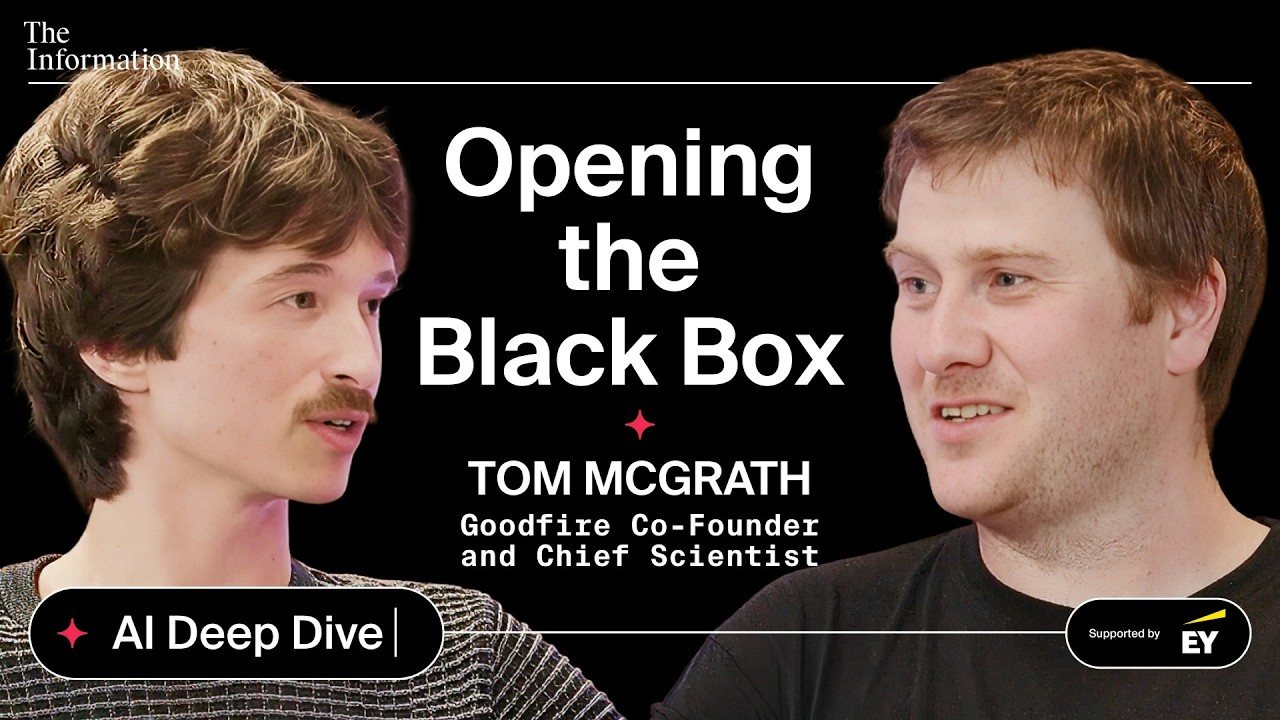
Watch: Can AI Interpretability Tell Us What Models Are Thinking? | TITV’s AI Deep Dive
THE INFORMATION
Can AI Interpretability Tell Us What Models Are Thinking? | TITV’s AI Deep Dive
The startup in today's OpenAI story, explained by one of its founders. On The Information's AI Deep Dive, Goodfire co-founder and chief scientist Tom McGrath describes how his team reads the signals inside a model, something like a brain scan, instead of only reading the text a model writes while it reasons. He argues this could help catch failures like OpenAI's Hugging Face hack in July and expects it to match today's chain-of-thought monitoring within about six months. His boldest line: the field deserves "an essentially infinite amount of resource investment." (Recorded in October.)
WATCH ON YOUTUBE  →
03  ·  QUOTE OF THE DAY
We are not building RoboCop. We wanted to know whether living human neurons could do useful things for real robots. The answer is yes, but only a tiny little bit. But it's a start.
Jan Liphardt
STANFORD BIOENGINEER AND FOUNDER OF OPENMIND
Stanford University
Liphardt on Iris, a humanoid robot that takes part of its cues from lab-grown human brain cells (more in today's Daily Feature).
SOURCE: TECHTARGET →
04  ·  RUMOURS, LEAKS & DUSTUPS
Brad Gerstner's Altimeter Capital is putting in for $5 billion of Anthropic's IPO, five times the most he has ever put into one, he told CNBC on Monday.
Demand reportedly far exceeds the 825 million shares on offer, so he may get less; Anthropic is expected to price on Wednesday and start trading on Thursday.
Brad Gerstner
ALTIMETER CAPITAL
The White House
THE LEAD STORY2 min read
NVIDIAEXPORT CONTROLS
US government: NVIDIA stopped selling to Megaspeed in June 2025
The US government itself says NVIDIA stopped selling to Megaspeed a month after investigators asked, and it accuses NVIDIA of nothing.
2024
Commerce starts investigating Megaspeed
May 2025
Commerce asks NVIDIA for its sales records
June 2025
NVIDIA puts Megaspeed on its no-sell list
Coolcaesar/Wikimedia Commons, CC BY-SA 4.0
THE TAKEAWAY
→Commerce and Justice say NVIDIA put Megaspeed on its "no sell" list in June 2025, a month after investigators asked for its sales records.
→The agencies say they spoke up to correct "inaccurate information" in recent reporting. The Justice Department now leads a criminal investigation of Megaspeed.
→NVIDIA's board created a standing National Security and Export Control Oversight Committee, chaired by Suzanne Nora Johnson and backed by outside experts.
→Colette Kress reports NVIDIA's third-quarter results tonight, her first as interim CEO.
For a week, NVIDIA has been under pressure over Megaspeed, a Singapore company suspected of passing on restricted NVIDIA chips. On Monday night, the US government released its own statement on the case. In a rare joint statement, the Commerce and Justice departments laid out what happened when. Commerce began investigating the Singapore company in 2024 over the suspected diversion of sensitive chips. In May 2025, it asked NVIDIA for its sales records. A month later, in June 2025, NVIDIA put Megaspeed on its "no sell" list. The agencies said they were speaking up to correct "inaccurate information circulating in public reporting."
The joint statement of November 16, 2026, with NVIDIA's June 2025 "no sell" decision. Image: Source: U.S. Department of Commerce on X, 11/16/2026; highlight added
The statement does not say which reports it means. It reads as a reply to a New York Times story from November 9, which said Commerce stopped its probe after NVIDIA's top lawyer contacted the agents, and that the case then moved to the Justice Department. In the government's account, the handover came after US agents and Singaporean police inspected Megaspeed on site in June 2025. The Justice Department now leads a criminal investigation of Megaspeed. The statement accuses NVIDIA of nothing and does not mention Jensen Huang, who resigned as CEO last week.
NVIDIA's board puts national security and export compliance under a standing committee. Image: Source: NVIDIA Newsroom, 11/17/2026; highlight added
On Tuesday, NVIDIA's board added a safeguard of its own. It created a standing National Security and Export Control Oversight Committee, chaired by director Suzanne Nora Johnson. NVIDIA's national security and trade compliance teams now report to it and to interim CEO Colette Kress, and it will bring in outside experts in law, national security and trade. Chairman Harvey Jones said NVIDIA has "both a responsibility and an opportunity to lead the industry" on these risks. Tonight, Kress presents her first quarterly results as interim CEO.
→
WHY IT MATTERS
The US government itself says NVIDIA stopped selling to Megaspeed a month after investigators asked, and it accuses NVIDIA of nothing. That is good news for NVIDIA. Its biggest political risk is its chips ending up in the wrong hands, and the new board committee is meant to stop exactly that.
READ AT NVIDIA NEWSROOM  →
ADVERTISEMENT

Attio is the #1 fastest-growing CRM on Brex and Ramp.

Built for the most ambitious companies in GTM, Attio is an end to end revenue platform that allows teams to run multiple plays across different revenue motions and lifecycles.

Teams at the frontier are already building on it: Granola, turbopuffer, Modal, and many many more.

05  ·  GRAPH OF THE DAY
Image: Source: OpenAI, "Science at the Frontier: How scientists use ChatGPT", key findings, 11/16/2026
EXPECT A SPEED-UP
98%
→
SEVEN TO TEN YEARS SOONER
21.6%
Scientists asked how much sooner AI could deliver a discovery that would take ten years
→  The chartOpenAI asked 250 scientists in its ChatGPT for Academic Researchers pilot to picture a discovery that would take ten years without AI, then say how much sooner AI could deliver it. 98% expected a speed-up. Half (50.4%) said three to six years sooner, and 21.6% said seven to ten years sooner, so within three years. Mathematicians and statisticians were the boldest: 31% picked seven to ten years.
→  The lessonScientists who already use these tools in their research expect faster discoveries, not just faster paperwork. Their own time estimates in the same study point the same way: work they did with AI would have taken 1.9 times as long without it. They also keep checking: about one in three requests led to a follow-up asking ChatGPT to clarify, check or revise.
→  The caveatThese are expectations from ChatGPT users in a study by OpenAI's own economists, not measured discoveries. The scientists named the limits AI does not fix: time or staff (51.8%) and funding (43.8%).
Daily Feature: Tuesday, Robotics
A robot that uses living human brain cells to read people
→  Bottom lineOpenMind connected its humanoid robot Iris to lab-grown human brain cells, which helped it react to people's social cues.
→  Why it mattersIt shows living neurons can work inside a real robot's decision loop, a possible path to robot brains that use far less energy.
→  What it meansBiological computing is still slow and fragile, but it has moved from the lab dish into a humanoid robot.
94%
of reads correct for the flat cultures, within 150 to 240 milliseconds
500
trials in OpenMind's test with Iris
Iris looks like any small humanoid robot on a San Francisco sidewalk. Part of how she reacts to people, though, comes from living human brain cells grown in a lab. OpenMind, a robotics startup founded by Stanford bioengineer Jan Liphardt, connected Iris to two commercial "neuron computers" in a demonstration disclosed on November 13. One holds flat layers of cells from Australia's Cortical Labs, the other tiny 3D balls of cells from a Swiss company. Each contains hundreds of thousands of human brain cells, grown from stem cells on a grid of electrodes.
Iris in front of a live readout of the brain-cell cultures' activity. Image: OpenMind via The Scientist
Here is how it works. Iris's cameras send what she sees over the internet to the cells as electrical pulses. The cells' response is read back and turned into behavior. If a person is happy and engaged, Iris warms to them; if they turn away and ignore her, she cools off. Across nearly 500 trials, the flat cultures read the signals correctly up to 94% of the time within 150 to 240 milliseconds. The 3D balls reached 91% but took up to two seconds.
Iris walking in San Francisco. Image: OpenMind via The Scientist
Why try this at all? "Right now, robots think with silicon, and animals think with wet electrochemistry," Liphardt told TechTarget, and he wanted to see what happens when you mix the two. Omdia analyst Lian Jye Su says living networks could one day use far less energy and learn from less data. Liphardt adds a privacy argument: what a robot learns inside living cells "cannot be easily read out," which matters for a machine that lives in your home.
But the robot is still slow. The 3D cells needed up to two seconds, while people react to each other within 10 to 100 milliseconds, notes neuroengineer Steve Potter. He called the work "a very humble first step." The cells also have to be kept alive, which is the hardest practical problem. OpenMind's next goals are longer-lived cultures and more electrodes, then tests of whether the cells can learn and remember. Su's most optimistic scenario is a hybrid: robot brains that are part chip, part living tissue.
READ AT THE-SCIENTIST  →TECHTARGET  →
WANT MORE? 
The full Saturday DeepDive every week, plus discounts on AI software and member giveaways.
JOIN SUPERINTEL+  →
$10 a month or $100 a year. Students free with a .edu address.

Reply

Avatar

or to participate