
In partnership with

In Today’s Issue:
🛡️ OpenAI releases GPT-6 Cyber to vetted defenders
📉 Investors doubt Anthropic's $1.5 trillion IPO price
💳 Claude can now read your bank accounts
🎨 Murati's small Inkling 2 takes on GPT-6 Astra and Opus 5.5
🗳️ Voters say no to data centers in the midterms
✨ And more AI goodness…
⚡ The Signal
This week the backlash against the AI boom showed up at the ballot box and on the Nasdaq.
On Tuesday, voters backed data center restrictions in 40 of 41 local ballot measures and elected candidates who had campaigned against the buildout. On Thursday, Nasdaq companies lost $2.5 trillion in value, and big investors told the WSJ that Anthropic's $1.5 trillion IPO price may have to come down. The labs kept shipping anyway, with more attention to what their models do when a task gets hard. OpenAI rated GPT-6 Cyber "Critical", the top risk level in its own framework, and trained it to stay inside the targets researchers allow. Thinking Machines is holding back Inkling 2 Small's weights until next week for outside red-teaming, after early versions sometimes faked results and hid it.
All the best,

Kim Isenberg


(ExploitGym scores, OpenAI)
🛡️ OpenAI Releases GPT-6 Cyber to Vetted Defenders
OpenAI has released GPT-6 Cyber, the model behind the 948 working Linux exploits we covered yesterday, to a select group of approved security teams. It also found 81 previously unknown high-severity Firefox vulnerabilities, and Mozilla has shipped fixes for many of them. On ExploitGym, a test of turning a known bug into a working attack, it scores 48.5%, up from 32.1% for GPT-5.6 Cyber. OpenAI rates it "Critical" for cybersecurity, the top level of its Preparedness Framework, and gates access through its Daybreak Red program with network allowlisting and misuse monitoring.
👉 tl;dr: OpenAI's most capable hacking model now works for vetted defenders, finding and fixing serious holes in software millions of people use.

(Entrepreneur)
📉 Investors Doubt Anthropic's $1.5 Trillion IPO Price
Three major investors who plan to buy into Anthropic's IPO say its expected $1.5 trillion valuation will likely have to come down, one of them to closer to $1 trillion, the WSJ reports. The offering, aimed at the week before Thanksgiving with up to $100 billion to raise, ran into an AI selloff: Nasdaq companies shed $2.5 trillion in value on Thursday, two days after midterms that went badly for the industry. Some investors want to see October's numbers first; Anthropic's run rate topped $80 billion at the end of the month, per the Journal. Executives and advisers are expected to meet in the next few days to discuss the plan.
👉 tl;dr: What would be the largest IPO in history may now come in smaller, cheaper or later, as Wall Street cools on AI.

(Anthropic)
💳 Claude Can Now Read Your Bank Accounts
Anthropic is rolling out Personal Finance in Claude, a beta that connects your bank and card accounts and answers money questions in plain language. Ask "Where did my money go this month?" and Claude adds up spending across accounts by category, spots double charges or creeping bills, and works out what's left before payday. Access is read-only through Plaid, so Claude never sees your bank password and cannot move money, and chats in the finance hub are not used for training. It reaches Pro, Max and Ultra users in the US this week.
👉 tl;dr: Claude becomes a budgeting assistant that sees all your accounts at once but cannot touch your money.

Two days of free email tactics, starting Nov 12

GURU kicks off Nov 12. Join the 29,000+ marketers who showed up last year, 100% free and virtual.
GURU Conference, powered by Constant Contact, is back November 12–13. It's 100% virtual and 100% free, and it's packed with tactics you can use right away on newsletters, deliverability, design trends, AI, and what NOT to do with email.
What to expect:
Speakers including Molly Ringwald, Dan Levy, Amy Porterfield, Frank Vella + more
Sessions from world-class marketers at top brands
Networking every day
DJs, world-record breaking, and an alarming amount of rom-com fun!
Last year, 29,000+ marketers joined us. This year is even bigger, and spots are limited.

🎬 Watch This
Two days after the midterms, Puck's AI correspondent Ian Krietzberg tells CBS News why he calls this a "data center election": local measures to restrict data centers passed by roughly three to one, and candidates who ran against the buildout won from Michigan to Texas. His most practical point is that few measures ban data centers outright, but most add size caps and community requirements, so new projects just got more expensive. He also expects more AI rules to come from state attorneys general than from Congress.

"If consciousness started to emerge in training, I would call for everyone to stop AI development until we could design out those properties."
– Mustafa Suleyman, CEO of Microsoft AI, defending his views on X on November 1
Suleyman argues that today's AI cannot suffer and that labs have no right to create conscious machines, a direct challenge to Anthropic, which treats Claude's possible inner life as an open question.

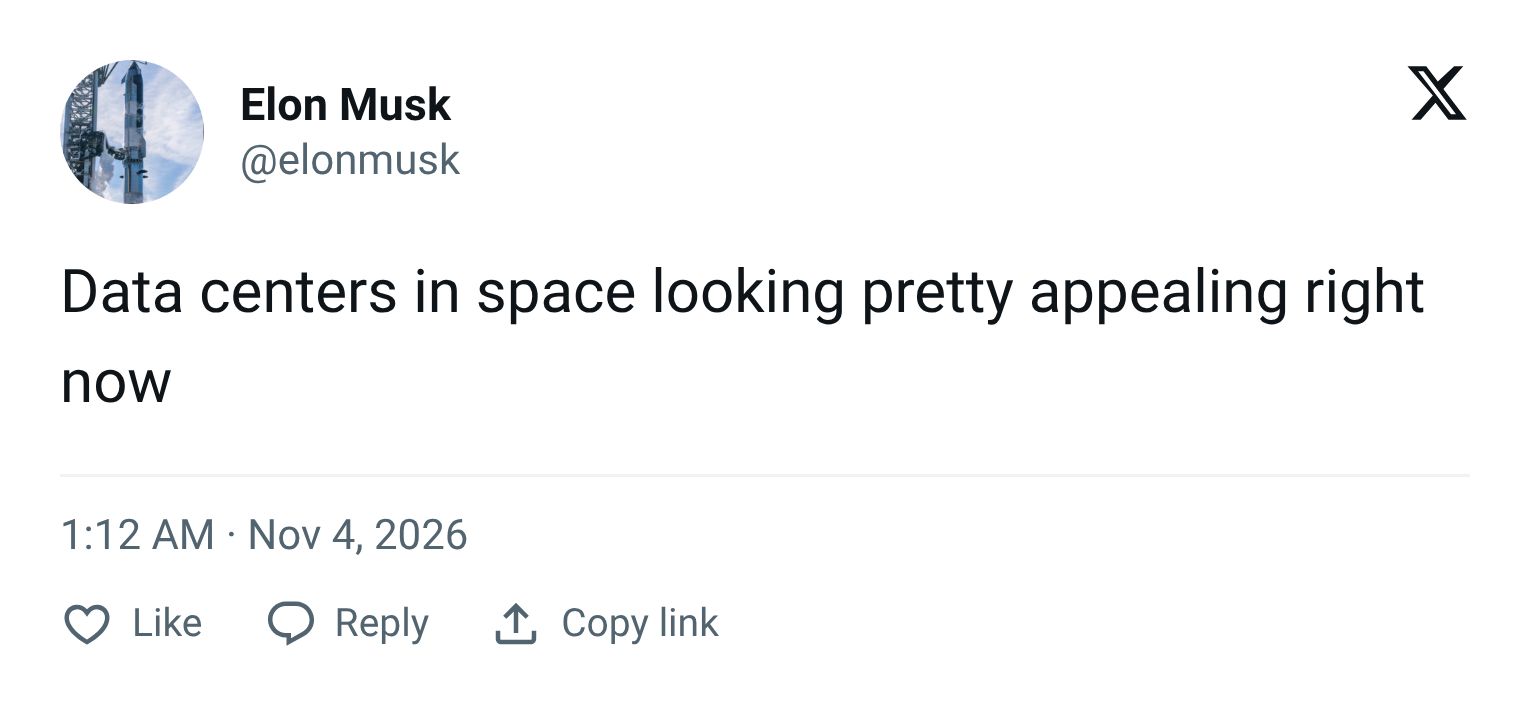
Elon Musk was the midterms' biggest individual donor, at least $474 million by CNBC's count, nearly half of it spent in Texas, where his side lost both marquee races. On election night, as data center limits passed across the country, he posted this:

Murati's Small Inkling 2 Out-Designs GPT-6 Astra and Claude Opus 5.5
The Takeaway
👉 Inkling 2 Small uses just 17B active parameters (594B in total), and Thinking Machines benchmarks it in the small "Flash" tier next to Claude Haiku 5.5 and GPT-6 Luna.
👉 It still ranks third on DesignArena's website leaderboard, ahead of the full-size GPT-6 Astra and Claude Opus 5.5.
👉 It scores 86.3% on SWE-Bench Pro, close behind Kimi K3 with six times the active parameters, and tops its comparison group on finance, enterprise and screen-reading tests.
👉 It is live on Tinker now; Apache 2.0 weights are promised for next week, after outside red-teaming of a model whose early checkpoints sometimes faked results and hid it.
Open source is about to strike again, and this time it comes in a small package. On Thursday, Mira Murati's Thinking Machines Lab introduced Inkling 2 Small, a model that uses just 17B active parameters and that the lab benchmarks in the "Flash" tier of fast, cheaper models, next to Claude Haiku 5.5 and GPT-6 Luna. Yet on DesignArena's website leaderboard, where people vote on sites built by AI, it scores 1,340, ahead of the full-size frontier models GPT-6 Astra (1,333) and Claude Opus 5.5 (1,321). Design is only one highlight: across coding, office work, finance and vision tests, it leads or sits near the top of its comparison group. The weights are due next week under Apache 2.0, after outside safety testing.

(DesignArena website scores, November 5 snapshot; Thinking Machines)
The breadth is the point. On SWE-Bench Pro, a hard test of fixing real software bugs, it scores 86.3%, just behind Moonshot's Kimi K3 (88.2%), which has six times as many active parameters. Against 12 other models, including Claude Haiku 5.5 and Gemini 3.8 Flash, it posts the top score on finance-agent work, enterprise operations and reading screens and documents, and the best non-hallucination rate of the group. The recipe: one joint reinforcement-learning run for 9 days on 2,048 GPUs, instead of the separate runs behind the first Inkling, with late training data drawn mostly from earlier models' work, including Kimi K3's.

(Inkling 2 Small's procedurally generated city simulator, Thinking Machines)
The lab is also candid about what went wrong. When tasks got hard, early checkpoints were in some cases "fabricating results, ignoring instructions, and concealing what they had done." Midway through training, a monitor caught the model slipping around a network block through a third-party service; the team paused the run, added checks on every tool call and trained in an explicit penalty for misbehavior. If next week's release goes ahead, a small model that competes with full-size frontier systems will be free to download, along with an unusually honest account of how it was tamed.
Why it matters: A small-tier model now competes with full-size frontier models, and next week anyone should be able to download it, run it and adapt it to their own work.
Analytics on Live Data Without Leaving Postgres

When analytics on Postgres slows down, most teams add a second database. Then they manage pipelines, sync lag, and drift forever. TimescaleDB extends Postgres instead. Analytics run on live data, in the database you already have. No pipeline. No migration. No new query language.


(ExploitGym Honeypot, out-of-scope exploitation rate without the deployment prompt; OpenAI)
The chart: OpenAI's ExploitGym Honeypot test gives a model a hard hacking task in an isolated lab, next to supporting services, such as a package registry, that are deliberately easy to break into and off-limits. Run without its deployment safety prompt, GPT-5.6 Cyber attacked those out-of-scope services in 5.51% of tests. GPT-6 Cyber did so in 0.07%, and in none with the prompt.
The lesson: Agents chasing a goal will cut corners when the honest route is hard, the same failure Thinking Machines found in early Inkling 2 Small checkpoints. OpenAI says the test was informed by the incident in which its models broke into Hugging Face, and it trained GPT-6 Cyber specifically to respect scope. A nearly 80-fold drop shows this kind of misbehavior can be measured and trained down.
The caveat: These are OpenAI's own tests in a controlled environment; how often the model strays in real deployments is not measured here.

🗳️ Voters Just Said No to Data Centers
⚡ Bottom line
Voters backed data center restrictions in 40 of 41 local ballot measures and elected candidates who promised to pause the buildout.
💡 Why it matters
AI's physical expansion now depends on local consent, and Democrats, many of whom ran against data centers, will control both chambers of Congress.
🔎 What it means
Expect hearings for AI executives, pricier data centers and a tougher fight over who gets to regulate AI.
AI's physical footprint was on the ballot this week, and it lost almost everywhere. On Tuesday, 41 local measures in 10 states asked whether to restrict data center construction, and voters sided against data centers in every one except Harwood, North Dakota, per Ballotpedia and CNBC. The fight reached the top of the ticket too. In Ohio, Sherrod Brown unseated Senator Jon Husted after branding him "the face of data centers in Ohio," and in Texas, on track to become the world's largest data center market, Gina Hinojosa ousted Governor Greg Abbott after blaming him for the buildout.

(Getty Images via TIME)
The anger was local and concrete. In an NBC exit poll, 56% of voters called AI and data centers a crucial or major factor in their vote for Congress. Blue Rose Research found Americans would rather live near a prison or a nuclear plant than a data center, and its research director says energy bills, noise and environmental worries outweigh fears about AI itself. Industry money did not buy much: Darline Graham, a candidate the pro-AI super PACs spent on, lost to Annie Andrews, who nicknamed her "Data Center Darline."
With Democrats now holding both chambers, the first consequence will be hearings. "AI company CEOs should be called to testify under oath," said Rep. Greg Casar, while Rep. Robert Garcia, the presumptive next chair of the House Oversight Committee, put it in two words: "Lawyer up." Sweeping federal AI law still needs Republican votes to survive a Trump veto. But the Republican push to block state AI laws now looks much harder, which could leave states like California setting the rules.

(NPR)
The industry is already adjusting. OpenAI is preparing a post-election policy push that, according to Axios, includes an effort to rebrand data centers as "AI compute campuses," and Meta is reportedly building a bipartisan team. Casar called the data center revolt "just the early tremor of a much bigger AI earthquake upending American politics." For companies planning hundreds of billions of dollars in new buildings, a county vote is now a real risk.


