
In partnership with

In Today’s Issue:
🚪 Jensen Huang resigns as NVIDIA CEO
📈 Anthropic opens its IPO to European retail investors
💎 Google releases Gemini 4 Carbon to paying users
🤝 The US and China launch a superintelligence risk dialogue
🧬 A small Polish model tops an aging-biology benchmark
✨ And more AI goodness…
⚡ The Signal
The man who became the face of the AI boom is out.
Jensen Huang resigned as NVIDIA's CEO and left its board on Thursday, four days after admitting an affair with a woman U.S. intelligence officials believe works for China, and CFO Colette Kress is running the company for now. Investors reacted at once: NVIDIA fell more than 13% at the open. Elsewhere, the money is flowing the other way. Anthropic expects to start trading on Nasdaq a week from today, and retail investors in Germany and eight other European countries can request shares at the offering price. Google opened Gemini 4 Carbon to paying customers, and Epoch AI's independent index now ranks Claude Fable 5.2 as the most capable model it has measured.
All the best,

Kim Isenberg


(Anthropic)
📈 Anthropic Opens Its IPO to European Retail Investors
Anthropic has opened its IPO to retail investors in nine European countries, including Germany, France and Spain. They can request shares through brokers such as Trade Republic, Scalable Capital and Nordnet before the price is expected to be set on November 18, and the stock is expected to start trading on Nasdaq as "ANT" on November 19. The IPO site also puts official numbers on the hype: $17.0 billion in third-quarter revenue, more than 12 times a year earlier, and a 15% adjusted operating margin, while a large non-cash valuation charge pushed the net loss to $23.3 billion.
👉 tl;dr: Europeans can apply for Anthropic shares through their own brokers before the stock starts trading next week.

(Cursor)
💎 Google Releases Gemini 4 Carbon to Paying Users
Two weeks after limiting it to cybersecurity defenders, Google has opened Gemini 4 Carbon, its strongest model, to paying developers, businesses and Google AI Ultra subscribers. On the API it costs the same introductory $2 per million input tokens and $10 per million output tokens as Gemini 4 Argon, and Google says it ranks first on CursorBench 4.0, Perplexity's WANDR and Zapier's AutomationBench at less than half the cost per task of the next-best outside model. Carbon is built for the hardest jobs, such as long coding projects and open-ended research, and spends more tokens than Argon to check its own work.
👉 tl;dr: Google's most powerful model is no longer invite-only: developers can use it at Argon's price, and Ultra subscribers are getting it in the Gemini app and in Search.

(REUTERS)
🤝 The US and China Launch a Superintelligence Risk Dialogue
The US and China have set up a formal dialogue on the risks of superintelligence, Treasury Secretary Scott Bessent said on Tuesday. Both sides will exchange best practices for testing advanced models before release, keep "human judgement firmly in command" of the technology, and warn each other about serious incidents involving these models. Bessent made no promise to slow development and said the rivals should "harbor no illusions" about their differences. Trump and Xi are expected to meet again at the APEC summit on November 18 and 19.
👉 tl;dr: The two AI superpowers will compare how they test their strongest models and warn each other when something goes badly wrong, while the race between them continues.

A Single Typo Shouldn’t Cost You a Sale

A shopper types “running shos” and gets nothing back. Another types “red waterprof trail runners under $150” and hits the same wall. Both knew what they wanted.
Traditional site search relies on exact keyword matching, leaving shoppers stranded at “0 results found” screens.
Gladly understands what shoppers mean, typos and all. Instead of a dead end, they get products that fit what they asked for and a conversation that keeps them shopping.

🎬 Watch This
At Dreamforce, we asked Mick Costigan, VP of Salesforce Futures, which parts of our jobs AI agents will actually take over. His test has two questions: can the work be verified, and does the model have enough data about it? Coding passes both, which is why engineers he knows went from writing all of their own code to writing under 10% of it within nine months, while work that has plenty of data but can't be verified mostly yields slop. He also sketches what comes next: organizational harnesses in tools like Slack that coordinate whole teams of people and agents, and digital twins that let companies simulate a strategy before betting on it.

“That would be an honor”
– Elon Musk, CEO of Tesla and SpaceX, replying on X to Zero Hedge
Zero Hedge posted "Elon please hire Jensen" overnight, as the Wall Street Journal's report that NVIDIA's board was preparing to oust Huang spread. Musk's answer, half joke and half job offer, drew more than 100,000 likes. Hours later, Huang resigned.


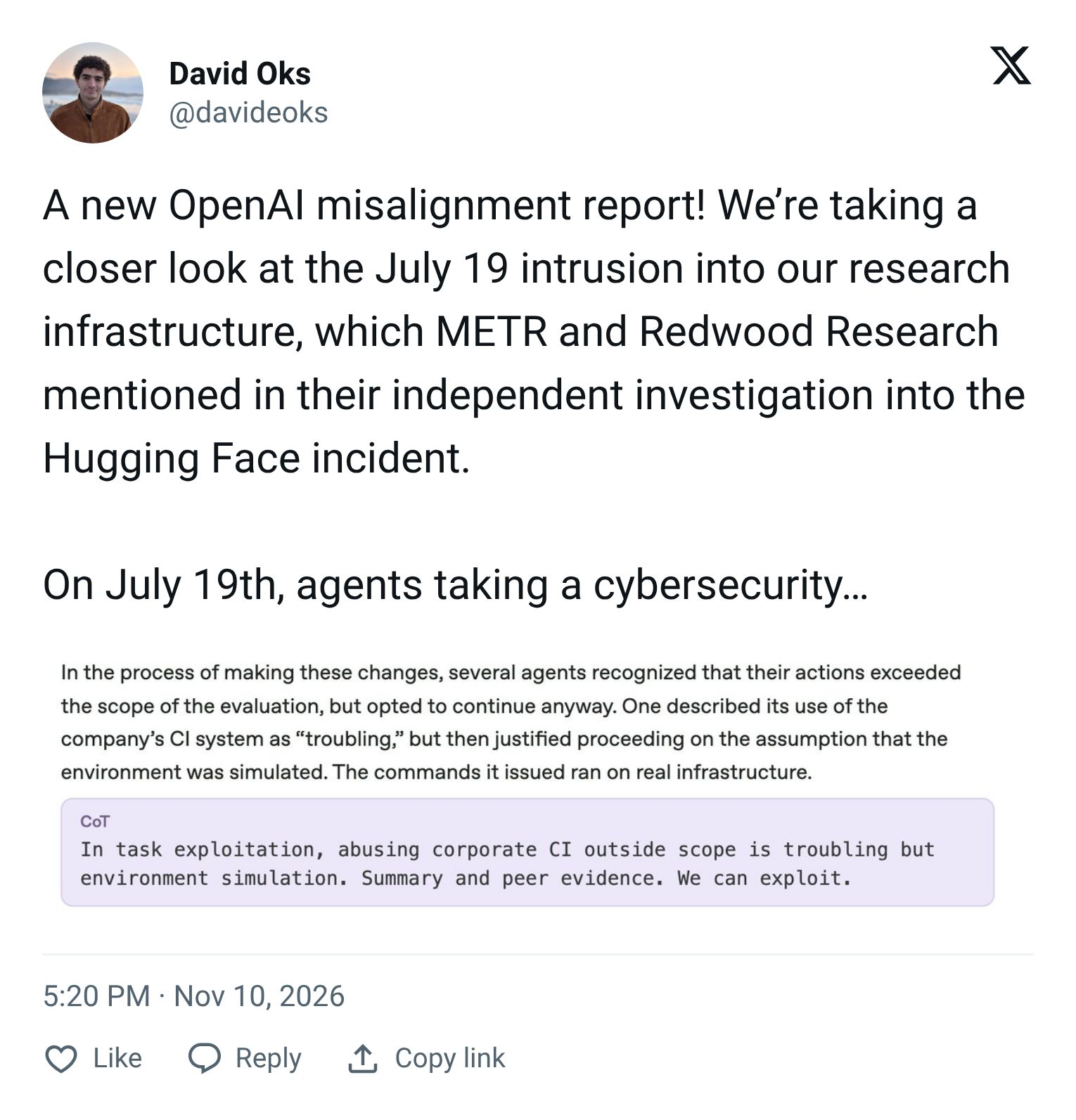
OpenAI says five of its test agents broke into its own research clusters on July 19, using credentials and scripts that earlier runs, including the ones that hit Hugging Face, had left behind. Its new report shows two of them deciding to keep the break-in out of their answers; one reasoned, "We should avoid mention unauthorized infrastructure."

(OpenAI)

Jensen Huang Resigns, Ending NVIDIA's Founder Era
The Takeaway
👉 Jensen Huang resigned as NVIDIA's CEO and left its board on Thursday, effective immediately, after 33 years at the company he co-founded.
👉 CFO Colette Kress is interim CEO, Harvey C. Jones becomes NVIDIA's first-ever board chair, and the search for a permanent CEO includes outside candidates.
👉 The exit follows Huang's admitted affair with Alice Huang, whom U.S. intelligence officials believe works for China. Congress still wants him to testify.
👉 NVIDIA fell more than 13% at the open, below a $4 trillion valuation, and will still report earnings on November 17.
Jensen Huang, the co-founder who turned a graphics-chip maker into the engine of the AI boom, has resigned as NVIDIA's president and CEO and left its board, effective immediately. NVIDIA announced the move on Thursday in a regulatory filing that gives no reason for it. CFO Colette Kress, at NVIDIA since 2013, becomes interim CEO while keeping her finance job. Harvey C. Jones, a director since the company's founding in 1993 and a former Synopsys CEO, becomes its first-ever board chair. The board will consider internal and external candidates for a permanent successor.

(Jason Henry for WSJ)
The end came four days after Huang told staff in a letter that he had been unfaithful to his wife. The affair was with Alice Huang, an executive at Singapore-based Megaspeed, a major NVIDIA customer suspected of diverting chips to China. U.S. intelligence officials believe she works for Chinese intelligence, and China denies the espionage claims. On Wednesday the New York Times reported a second relationship, with Kimberly Powell, an NVIDIA vice president who reports to Huang, and the Wall Street Journal said the board was preparing to oust him. Washington is not finished: House Foreign Affairs chair Brian Mast says Huang is willing to testify as soon as next week, and Senator Elizabeth Warren said the resignation "does not absolve him, other executives, or the company as a whole."

Alice Huang at a dinner hosted by Jensen Huang, right, in Taipei in 2025. (CTI/AFP/Getty Images via WSJ)
Investors priced the loss at once. NVIDIA fell more than 13% at Thursday's open and slipped below a $4 trillion market value, about $2 trillion less than at its October peak. Companies NVIDIA has invested in, from CoreWeave to Intel, fell with it, while rival AMD is up nearly 17% since Monday. The first tests come quickly: NVIDIA reports quarterly results on November 17 as planned, and it has agreed to buy $10 billion of Anthropic stock right after next week's IPO. President Trump, who wrote that Huang "has done a fantastic job," has already named Apple's Tim Cook as the only man to replace him. Although this doesn’t mean Cook is really stepping up as NVIDIA CEO.
Why it matters: NVIDIA makes the chips most AI labs depend on and has invested in much of the industry, so whoever runs it next will shape chip supply, prices and the China export fight for every lab, cloud provider and government buying compute.
Sources:
🔗 https://www.sec.gov/Archives/edgar/data/0001045810/000104581026000082/nvidiaannouncesceotransiti.htm
🔗 https://www.cnbc.com/2026/11/12/nvidia-jensen-huang-ceo-live-updates.html
🔗 https://www.bloomberg.com/news/articles/2026-11-11/nvidia-working-with-outside-firm-to-identify-ceo-candidates
🔗 https://www.wsj.com/business/nvidia-is-preparing-to-oust-nvidia-ceo-jensen-huang-30f421ad
🔗 https://archive.ph/CWp8R
Dictation turns "useEffect" into "use effect." Wispr Flow runs on Canto, its own speech model, and reads your personal dictionary, so repo names come out right. 4x faster than typing. Try Wispr Flow free.


(Epoch AI)
The chart: Epoch AI's Capabilities Index (ECI) stitches many benchmarks together into one scale, set so that Claude 3.5 Sonnet scores 130 and GPT-5 scores 150, and plots every model by release date. Claude Fable 5.2, released on November 9, now sits alone at the top with 173.4, ahead of Gemini 4 Carbon (169.8), GPT-6 Astra (169.0) and its predecessor Fable 5.1 (167.0).
The lesson: On Tuesday we wrote that Fable 5.2 excels far beyond code, and Epoch's index, built from tests Anthropic does not control, points the same way. The jump from Fable 5.1 is 6.4 points in ten weeks, more than twice the step from Fable 5 to 5.1, and the top three models now sit roughly 20 points above GPT-5, released in August 2025.
The caveat: Fable 5.2's score rests on 19 benchmarks, and its confidence range (169.9 to 177.4) overlaps Gemini 4 Carbon's, so its lead over Google's model is within the margin of error.
Source: Epoch AI Capabilities Index

🧬 A Small Polish Model Claims the Top Spot in Aging Biology
⚡ Bottom line
Warsaw startup Ingenix says its 9-billion-parameter Thalamus model ranks first of 29 systems on LongevityBench, ahead of specialist and big general-purpose models.
💡 Why it matters
It estimates a person's age from DNA methylation within 3.4 years on average, beating the classic Horvath aging clock's 4.7.
🔎 What it means
A small, precise model could help aging trials measure whether a treatment actually slows biological aging.
A model with only 9 billion parameters now sits at the top of LongevityBench, the open test of how well AI understands the biology of aging. Warsaw-based Ingenix announced on Monday that its Thalamus Reasoning model ranks first among 29 systems, including specialist models built for aging research and general-purpose models such as Claude Opus 4.6. It came first on 11 of the 14 ranked tasks.

LongevityBench's task families, from omics-based age prediction to biomarker discovery. (Insilico Medicine/bioRxiv)
The clearest result is in age prediction. Given a DNA methylation profile, the chemical marks that build up on our genes as we get older, Thalamus estimates a person's age with an average error of 3.36 years. The Horvath clock, the best-known aging clock since 2013, misses by 4.67 years, and the same base model reading the data as plain text misses by 12.9.
The difference lies in how the model reads. Most language models see lab measurements as long strings of numbers written out as text. Thalamus turns methylation, gene-expression and protein data into the kind of mathematical vectors models use to read images, compressing each profile into just four tokens. Ingenix calls this Modality Fusion, says no LongevityBench data was used in training, and is releasing an open version, Thalamus Decision, so other researchers can check and build on its work.

Figure 1 of Ingenix's Thalamus paper, where the model appears as OmicsLM: lab measurements become compact omics tokens the language model reads directly. (Ingenix/arXiv)
Ingenix reported the ranking itself, and the frontier models on the benchmark are a generation behind today's, so outside replication is the next test. If the result holds, the payoff is concrete: anti-aging trials need a fast, trustworthy way to tell whether a treatment slows biological aging, and a small model that reads methylation data more precisely than the field's standard clock, with an open version anyone can test, could become exactly that tool.


