
In partnership with

In Today’s Issue:
🕵️ Nvidia's board opens a spy probe after Huang admits an affair
🔐 DeepMind's AI agents find weak spots in old RSA encryption
💼 Consulting, law and accounting keep hiring despite AI fears
💊 Drugmaker CEOs push back on "AI will cure disease"
💸 OpenAI raises $11 billion below its target price
✨ And more AI goodness…
⚡ The Signal
Over the past week, AI's biggest claims ran into people who don't work for the companies making them.
Nvidia's board brought in outside counsel to investigate reports that Jensen Huang was the target of Chinese intelligence. METR, an independent auditor, found that Anthropic's progress has nearly doubled in speed, mostly because its own AI now speeds up its research, though Anthropic redacted much of the evidence and cut short part of the audit. October's jobs report showed consulting, law and accounting still hiring, and drugmakers told the WSJ that AI has yet to deliver an approved drug. Investors ran their own numbers too: OpenAI raised $11 billion, at a lower price than it wanted. The buildout goes on, and the claims behind it are now being checked from the outside.
All the best,

Kim Isenberg


(Google DeepMind research head Pushmeet Kohli, TIME)
🔐 DeepMind's AI Agents Find Weak Spots in Old RSA Encryption
Google DeepMind says AI agents, working under human supervision, found two new weaknesses in 1024-bit RSA, an older encryption standard used to sign and protect data. One is a way to forge digital signatures that DeepMind estimates is about 1,600 times better than the best previous method when an attacker controls part of the signed data. The other cuts the cost of cracking each additional 1024-bit key in a batch by about 30 times. Research head Pushmeet Kohli stresses that modern systems, which almost all use 2048-bit keys or larger, are not affected.
👉 tl;dr: AI agents found new ways to attack a retired encryption standard, so anyone still running 1024-bit keys has one more reason to upgrade.

(October job growth in three AI-exposed industries, WSJ)
💼 Consulting, Law and Accounting Keep Hiring Despite AI Fears
October's jobs report handed the "AI is killing white-collar work" story an awkward data point: professional and business services added 70,000 jobs, the most since July 2022. Consulting added 17,300 jobs, legal services 2,400 and accounting 2,300, all fields often ranked among the most exposed to AI. The losses showed up in routine work instead: in the year to September, document-preparation services cut 17% of their jobs and call centers 4.7%. "It's not the bloodbath among knowledge workers that a lot of people had feared," said Employ America economist Preston Mui. "At least not yet."
👉 tl;dr: So far AI is squeezing repetitive office jobs, while the skilled professions most exposed to it are still adding staff.

(Tony Luong for WSJ)
💊 Drugmaker CEOs Aren't Buying "AI Will Cure Disease"
Leaders at Vertex, AstraZeneca and Regeneron are pushing back on Silicon Valley's promise that AI will soon cure most diseases. Vertex let roughly 50 AI companies comb through its library of 10,000 compounds, and not one produced a working drug; executive chairman Jeff Leiden called one tech leader's claim that AI would cure 90% of disease within seven years "complete BS." Investors still put $8.4 billion into AI drug discovery in 2025, yet no AI-designed drug has won FDA clearance. The drugmakers do use AI, as a co-pilot for picking targets, refining molecules and finding the right patients.
👉 tl;dr: AI helps drugmakers pick targets and patients faster, but it has not yet produced an approved drug on its own.

A Single Typo Shouldn’t Cost You a Sale

A shopper types “running shos” and gets nothing back. Another types “red waterprof trail runners under $150” and hits the same wall. Both knew what they wanted.
Traditional site search relies on exact keyword matching, leaving shoppers stranded at “0 results found” screens.
Gladly understands what shoppers mean, typos and all. Instead of a dead end, they get products that fit what they asked for and a conversation that keeps them shopping.

🎬 Watch This
At GitHub Universe, we sat down with Jay Parikh, Microsoft's Executive Vice President of CoreAI, whose organization includes GitHub. He explains how Copilot Fusion decides how to run each request across one or more models instead of following a fixed routing rule, why AI code review, with 200 million findings delivered since launch, still ends with a human signing off, and how Copilot Dreaming learns from a team's finished work. His closing argument: the "potential intelligence" stored in today's models only becomes real value once someone builds software around it.

"It turns out AI is broad but not that deep. Until it can do the entirety of someone's job, it's hard to plug it in to totally replace a worker."
– David Deming, Harvard economist and Dean of Harvard College, to the Wall Street Journal on November 7
Deming was reacting to October's jobs report, in which some of the professions most exposed to AI kept hiring. His point: AI can already take over pieces of many jobs, but it rarely handles a whole one.

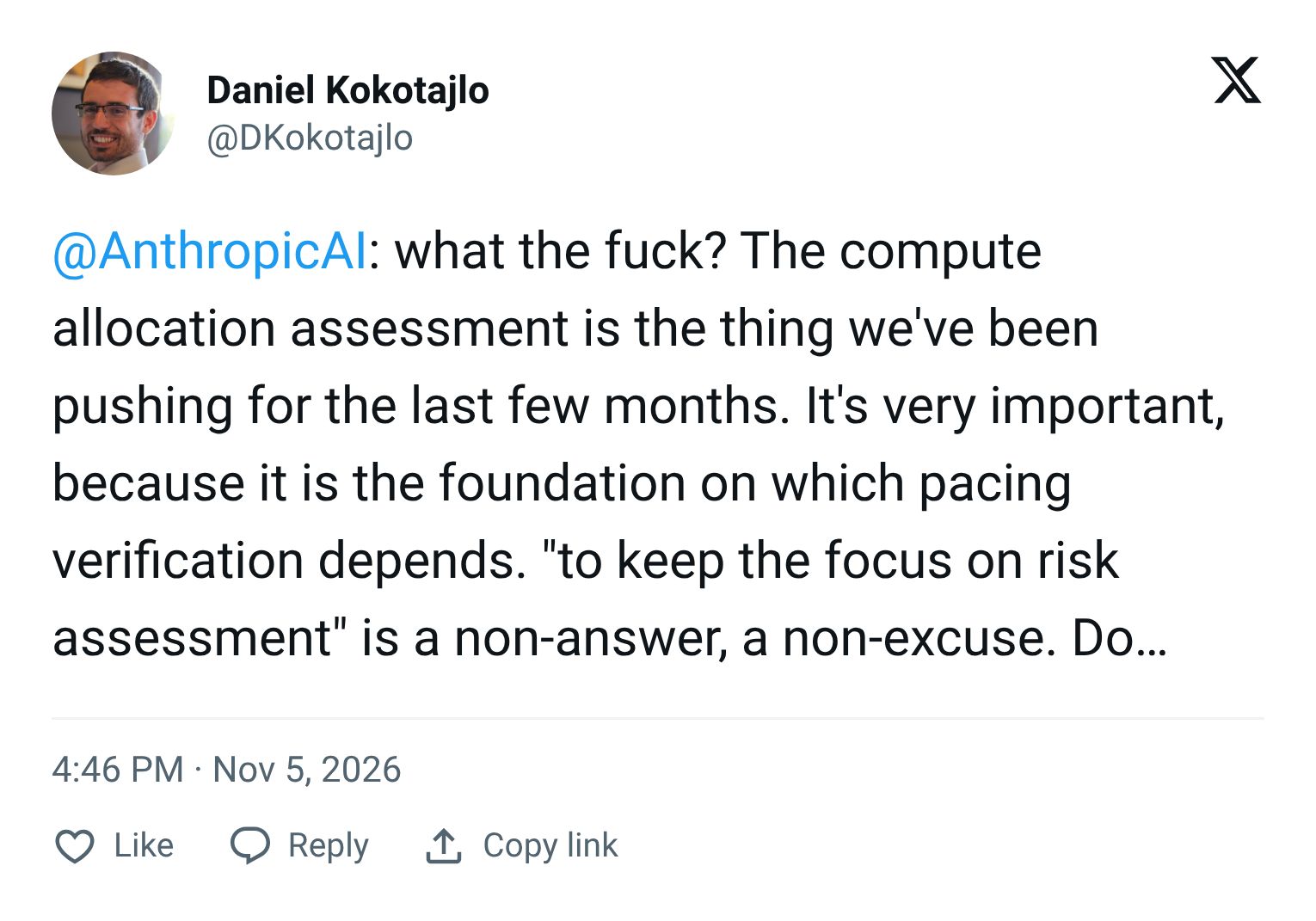
Anthropic gave the independent auditor METR unusually deep access, then cancelled the part of the audit that would have checked how it splits computing power between building more capable models and safety research. Anthropic says it wants to focus on risk assessment first. Daniel Kokotajlo, the former OpenAI researcher behind the "AI 2027" scenario, was not impressed:

Nvidia's Board Opens Spy Probe After Jensen Huang Admits Affair
The Takeaway
👉 Huang admitted an affair with a woman whom reports identify as Alice Huang, a former executive at Singapore's Megaspeed, suspected by the US government of being recruited by a Chinese spy agency.
👉 Nvidia's board formed a committee of independent directors with outside counsel, while saying it has "no reason to believe" national security or company secrets were compromised.
👉 President Trump called Huang a "fine person" who should stay CEO; key House Republicans had already asked for a briefing.
👉 Nvidia has no public succession plan, and its shares fell 3.7% in weekend trading on Robinhood after the news, with earnings due later this month.
Nvidia's board has opened an independent investigation into reports that Jensen Huang, the company's founder and CEO, was the target of a foreign intelligence effort. On the same Sunday, Huang told employees in a memo that he had been unfaithful to his wife. According to Bloomberg, the woman is the one at the center of those reports: Alice Huang, also known as Huang Le, a former executive at Megaspeed, a Singapore-based Nvidia customer accused of smuggling Nvidia chips into China. The US government suspects she was recruited by a Chinese spy agency. Huang had earlier described his contact with her as a "normal" business relationship, and China's foreign ministry called the spy claim a "smear."

(Jensen Huang; Getty Images via TechCrunch)
The board is keeping its claims narrow. A committee of independent directors, assisted by outside counsel, will "examine all available information," though the board says it has "no reason to believe" that national security or Nvidia secrets were compromised. Huang says he will cooperate fully. Washington weighed in quickly: President Trump called him a "fine person" who should stay CEO, while key House Republicans had already asked for a briefing on his dealings with the former Megaspeed executive.

(Statement from Nvidia's board, November 8; NVIDIA)
The stakes reach well beyond one marriage. Nvidia has no public succession plan, and Bernstein analyst Stacy Rasgon warns of "considerable key man risk": in his words, Huang "IS Nvidia," pulling most of the strings through a reported 60 direct reports. The timing is delicate, too. Congress is negotiating chip-location checks and export limits in the defense bill, and Bloomberg Intelligence expects tougher scrutiny of Nvidia's China sales once Democrats take over committees in January. Nvidia's shares fell 3.7% in weekend trading on Robinhood after the news, with earnings due later this month.
Why it matters: Nvidia dominates the chips that train and run AI, and Huang personally drives its strategy and its push to sell in China. Any doubt about his judgment now weakens Nvidia's hand in Washington's fight over chip exports.
Sources:
🔗 https://nvidianews.nvidia.com/news/statement-from-nvidia-board-of-directors
🔗 https://www.bloomberg.com/news/articles/2026-11-08/nvidia-board-to-probe-spying-case-after-ceo-jensen-huang-admits-infidelity?srnd=homepage-europe
🔗 https://nvidianews.nvidia.com/news/a-message-to-our-company


(METR, via The Decoder)
The chart: METR, the independent auditor from today's Rumours, plots Anthropic's models since Claude 3 Opus on the AECI, a combined score across many internal and public benchmarks, by the date most Anthropic staff got access. Orange dots are internal models the public has not seen. Until October 2025, the score rose about 15 points a year; since then, the trend has climbed about 29 points a year, roughly 1.9 times as fast.
The lesson: Anthropic now gets two years of progress in one, and METR estimates that about 80% of that speedup comes from Anthropic using its own AI in research, not from faster growth in training compute. One employee said the team is "no longer bottlenecked on code." METR sees no bottleneck likely to slow this over the next twelve months, and says Anthropic may have crossed its own warning threshold for AI-driven acceleration as early as July 15.
The caveat: The 95% range runs from 1.5 to 2.8 times, and Anthropic redacted most of the evidence METR found most informative.

💸 OpenAI Gets Its $11 Billion, Just Not Its Price
⚡ Bottom line
OpenAI raised $11 billion at a $1.25 trillion valuation, below the $1.4 trillion it reportedly sought in September.
💡 Why it matters
Companies keep using more AI, but their spending on it has grown far more slowly since summer, and investors are pricing that in.
🔎 What it means
AI labs now have to show that revenue keeps up with usage, starting with Anthropic's IPO.
OpenAI raised $11 billion on Friday, and the number investors noticed was the price. According to Bloomberg, the ChatGPT maker closed the first part of a new funding round at a $1.25 trillion valuation, with SoftBank and Abu Dhabi's MGX among the backers. In September, it was reportedly aiming for as much as $30 billion at $1.4 trillion. The round may now reach about $20 billion and is expected to close in the coming weeks.

(Samuel Boivin/NurPhoto/Getty Images via TechCrunch)
Part of the discount is timing. AI stocks sold off after last week's midterms, in which voters turned against data centers, and many investors now expect regulatory trouble. Hours before OpenAI's news, Bloomberg reported that some potential buyers in Anthropic's IPO see its value as low as $1.1 trillion, below the $1.5 trillion it was aiming for.
The bigger worry sits in the spending data. Ramp, a corporate-card company that tracks what businesses pay for AI, found that spending on AI models grew just 1.5% across August and September, after a 42% jump in July, even as usage kept rising. October picked up again, up 8.9%. Ramp economist Ara Kharazian blames price cuts and thriftier customers: OpenAI halved API prices for GPT-6 Sol and Luna in September, and companies now route simple jobs to cheaper models. "You can use more AI, but use it for less," he told TechCrunch.

(Ramp economist Ara Kharazian, TechCrunch)
That is the gap investors are now pricing in. AI use is booming, but cheaper models mean revenue does not automatically follow, and every lab selling tokens faces the same math. Notion co-founder Akshay Kothari put it bluntly: "tokens go brrr. costs go ahhh." For OpenAI, which is expected to go public next year, the next test is showing that revenue can grow as fast as usage.
Dictation turns "useEffect" into "use effect." Wispr Flow runs on Canto, its own speech model, and reads your personal dictionary, so repo names come out right. 4x faster than typing. Try Wispr Flow free.


