
In partnership with

In Today’s Issue:
⚡ Gemini 4 Hydrogen brings Google's new generation to everyone
🔐 TSMC confirms a leak of employee data through a cloud provider
💼 Colette Kress takes over a shaken NVIDIA
🛑 Microsoft's outage freezes Outlook, Teams and Copilot
🕵️ A researcher says Chinese labs built models on banned Blackwell chips
🗳️ Democrats bet on AI regulation for 2028
✨ And more AI goodness…
⚡ The Signal
Google just made its new model generation fast and cheap enough for everyone, in a week when the systems underneath AI looked unusually fragile.
Gemini 4 Hydrogen scores level with Google's own six-week-old Argon on Artificial Analysis's intelligence index for about a fifth of the cost per task, and it is rolling out in the Gemini app and Search. Meanwhile a Microsoft 365 outage that began Thursday evening knocked out Outlook, Teams and Copilot across the US, Asia and Europe, hitting even OpenAI and Anthropic. TSMC confirmed that records on its employees leaked through a cloud provider, and NVIDIA heads into Tuesday's earnings with interim CEO Colette Kress in place of Jensen Huang. Add a researcher who says he can read export-banned Blackwell chips out of Chinese model weights, and the pattern is hard to miss: intelligence gets cheaper every few weeks, while the chips, clouds and people behind it carry the risk.
All the best,

Kim Isenberg


(TSMC via Wccftech)
🔐 TSMC Confirms Employee Data Leaked Through a Cloud Provider
TSMC confirmed that data on current and former employees was posted online without authorization, after hackers offered a 6.9GB file on underground forums and demanded three Bitcoin. The chipmaker says the files match data stored with an outside cloud service provider and that it has found no evidence its own systems, operations or customer data were compromised. As proof, the hackers released details on 499 employees, including addresses and bank account numbers, the kind of data that fuels phishing at the world's most important chipmaker.
👉 tl;dr: Personal and bank details of TSMC staff are circulating after a breach at a cloud supplier, while TSMC says its chipmaking and customer data are untouched.

(The Information; photo: Getty Images)
💼 Colette Kress Takes the Wheel at a Shaken NVIDIA
NVIDIA's longtime finance chief Colette Kress is now interim CEO after Jensen Huang resigned on November 12, and The Information reports she sometimes pushed back on his riskiest bets. She resisted a proposed $250 billion NVIDIA credit backstop for OpenAI's data centers, which was later split in two with about $100 billion guaranteed so far, and she worked to keep NVIDIA's financial risk from piling up in a handful of customers. That caution meets a nervous market: one cloud buyer told The Information it is now weighing Google and AMD chips, saying "We would be an idiot not to."
👉 tl;dr: NVIDIA is now run by a cautious finance chief, which could mean fewer giant financing deals for AI labs and a harder fight to keep big customers from trying rival chips.

(Getty Images via BBC)
🛑 Microsoft Outage Freezes Outlook, Teams and Copilot Worldwide
A Microsoft 365 outage that began around 6pm GMT on Thursday knocked out Outlook, Teams, Copilot and OneDrive for millions of users, from government agencies in Japan and Australia to Britain's NHS and the Bank of England. Microsoft blamed some servers becoming overloaded after others went "unexpectedly unavailable", said it saw no sign of a cyberattack, and by midday Friday reported "encouraging recovery progress in Europe". OpenAI and Anthropic were among the companies hit.
👉 tl;dr: Microsoft's everyday work tools have been down or degraded for about a day across three continents, and recovery is still rolling out region by region.

10 Stocks at the Center of AI’s $1 Trillion Boom

AI’s growth story is much bigger than chatbots.
The market was already valued at an estimated $800 billion by late 2025, and continued adoption could push it beyond $1 trillion in the years ahead. That growth will require more data centers, computing power, software, networking and intelligent devices.
But the most obvious AI names may not be the only companies positioned to benefit.
MarketBeat’s free 10 Best AI Stocks to Own in 2026 report identifies ten publicly traded companies helping power the next phase of the AI buildout. Some are established leaders. Others occupy less obvious corners of the expanding AI ecosystem.
This free report names 10 stocks positioned to ride that wave before the rest of the market catches on.

🎬 Watch This
Why do so many enterprise AI pilots shine in a demo and then never ship? Christian Monberg, CTO and Head of Product at Zeta Global, gave us a blunt answer: companies pile up a thousand little tools that work in isolation, while the real bottleneck is still data access and governance. He explains how Zeta's Athena assistant works inside Palantir Foundry, why agents need mandatory circuit breakers before irreversible steps like large data merges, and why an open model post-trained on Zeta's own codebase matched a frontier model for one of his engineers.

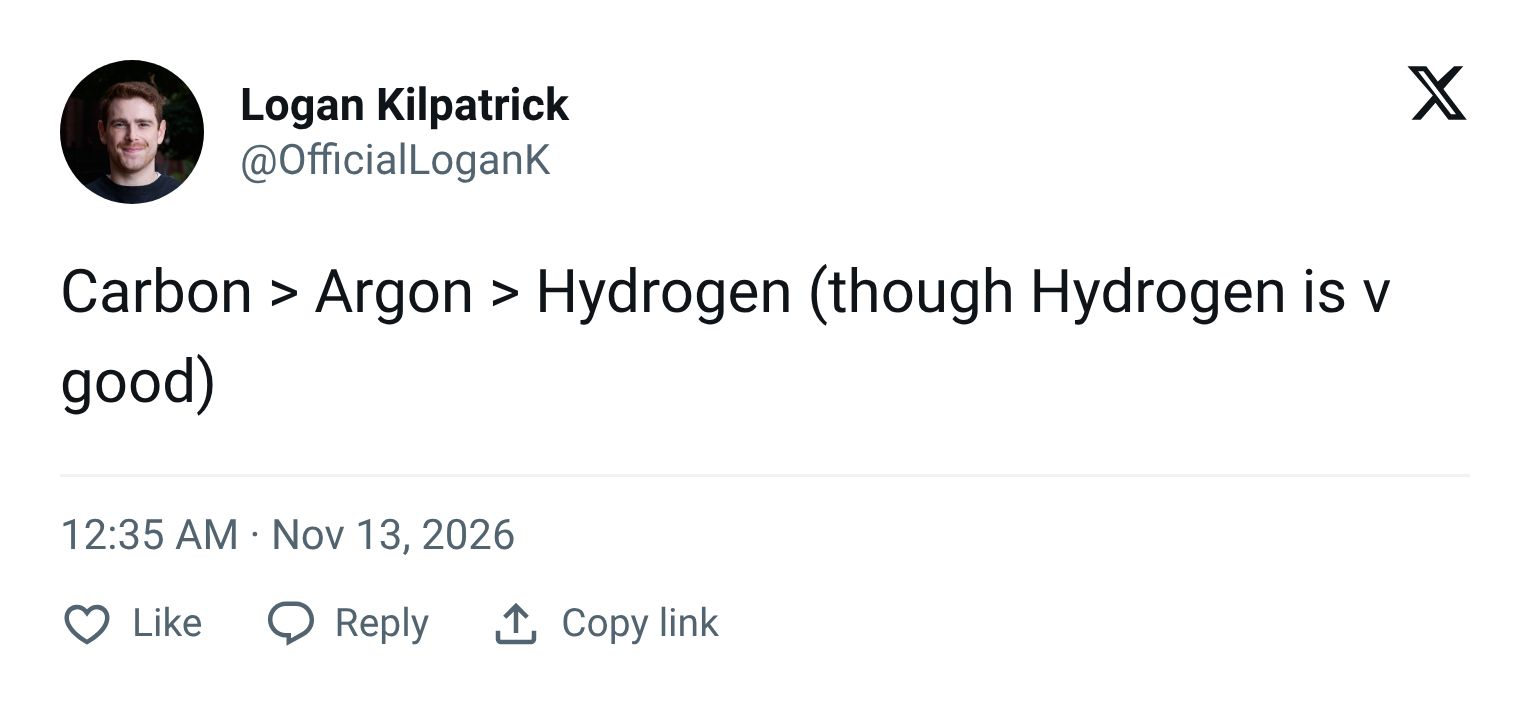
“Carbon > Argon > Hydrogen (though Hydrogen is v good)”
– Logan Kilpatrick, who works on Gemini, Google AI Studio and the Gemini API, on X
A developer wrote that he loved the new element names but could not remember which Gemini 4 model was best. Kilpatrick's one-line reply is the clearest buyer's guide yet: Carbon for the hardest problems, Argon next, Hydrogen for fast everyday work, even though Hydrogen scores level with Argon on Artificial Analysis's index at its default setting.

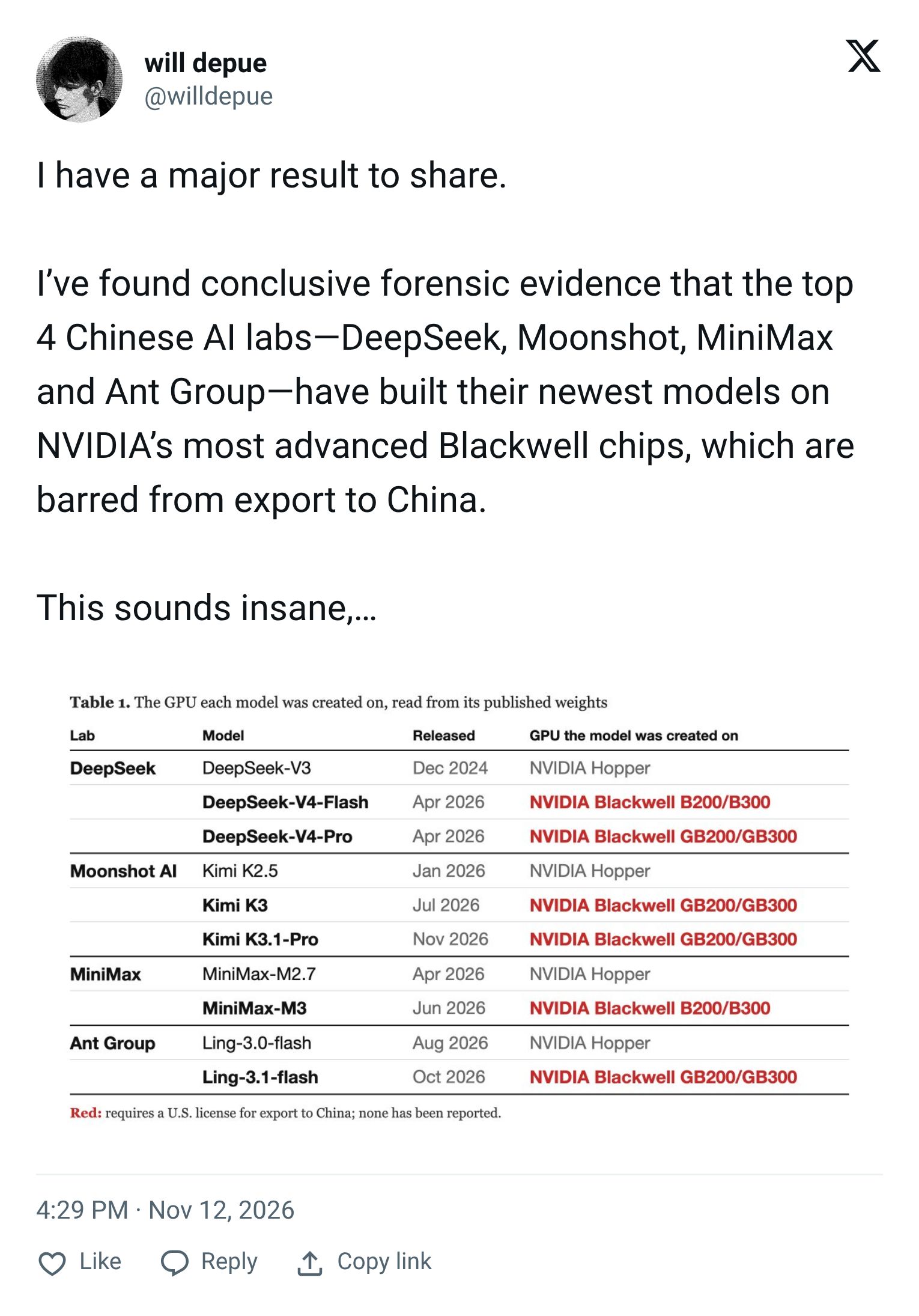
Will Depue, who worked on Sora at OpenAI, says a model's published weights carry a fingerprint of the GPU it was set up on, and that DeepSeek, Moonshot, MiniMax and Ant Group built their newest models on NVIDIA's export-banned Blackwell chips. He reproduced DeepSeek-V4-Flash's starting weights bit for bit on a Blackwell B300 and says senior researchers at OpenAI and Anthropic verified the result.

Gemini 4 Hydrogen Brings Google's New Generation to Everyone
The Takeaway
👉 Gemini 4 Hydrogen is the fast tier of Google's new generation, rolling out in the Gemini app, Search, AI Studio and the Gemini API, and for paid AI Pro and Ultra subscribers in Antigravity.
👉 At its default setting it scores 51 on the Artificial Analysis Intelligence Index, one point above Gemini 4 Argon, for about a fifth of Argon's cost per task.
👉 Against Gemini 3.8 Flash, Google says it finishes tasks 2.5x faster, more than triples the Terminal-Bench 4.1 score (57% vs 18.2%) and makes over 5x fewer fabricated claims.
👉 It costs $1.50 / $7.50 per million input/output tokens across a 1 million-token context window, with four thinking levels up to a new xhigh.
Google has put its new Gemini 4 generation into everyone's hands. Gemini 4 Hydrogen, released on Thursday, is the fast, efficient sibling of Carbon and Argon, the heavyweight reasoners Google shipped over the past six weeks. It is built for rapid execution: writing code, running tests, digging through documents and handling everyday chat. The jump over its predecessor, Gemini 3.8 Flash, is big. Google says Hydrogen finishes tasks 2.5 times faster, more than triples Flash's score on Terminal-Bench 4.1 (agentic coding in the command line) and makes over five times fewer fabricated claims.

(Google DeepMind)
Google wants it as the workhorse beside its bigger models. Four thinking levels, including a new xhigh, let developers pay only for the reasoning a task needs. In Google's coding tool Antigravity, a new Orchestrator switches between Carbon and Hydrogen within the same session, so the big model handles judgment calls and the fast one does the legwork; on Terminal-Bench 4.0 that mix came close to Carbon's success rate while using 24% less quota and finishing 19% faster. Independent testers back the speed story: Artificial Analysis scores Hydrogen 51 at default settings, one point above Argon, at about a fifth of Argon's cost per task.
I had early access, and it is a seriously good model for a fast tier. In Antigravity I asked Hydrogen (on high) for a futuristic city I could fly through, and after one follow-up it delivered a Three.js world with procedural towers, rain and flying traffic. A black-hole scene with light bending around a glowing disk came out with zero follow-ups. Speed usually costs quality; here it barely did.

(Kim Isenberg / built with Gemini 4 Hydrogen)

Why it matters: Most people never pick a model from a menu; they use whatever Google puts in Search and the Gemini app. Putting a model that scores level with six-week-old Argon into those products, at a fraction of the cost, lifts the everyday baseline for anyone who uses Google.
Stop Drowning In AI Information Overload

Your inbox is flooded with newsletters. Your feed is chaos. Somewhere in that noise are the insights that could transform your work—but who has time to find them?
The Deep View solves this. We read everything, analyze what matters, and deliver only the intelligence you need. No duplicate stories, no filler content, no wasted time. Just the essential AI developments that impact your industry, explained clearly and concisely.
Replace hours of scattered reading with five focused minutes. While others scramble to keep up, you'll stay ahead of developments that matter. 600,000+ professionals at top companies have already made this switch.


(Google DeepMind, data: Artificial Analysis)
The chart: Google plots each model's score on the Artificial Analysis Intelligence Index, a combined score across nine tests, against what it costs per task, with one dot per thinking level. Gemini 4 Hydrogen climbs from 27 at low (about $0.29 a task) to 51 at high ($1.87) and 54 at the new xhigh ($3.16). Claude Sonnet 5.5 needs roughly $10 a task to reach a similar top score.
The lesson: The four thinking levels work like a price ladder: pick the depth a task needs and pay only for that. At every rung Hydrogen is cheaper than Sonnet 5.5 for the same score, and Artificial Analysis finds that at high it matches Google's own Gemini 4 Argon for about a fifth of Argon's cost per task. It also rarely bluffs: when it does not know an answer on AA's hallucination test, it guesses only 8% of the time, against 43% for Sonnet 5.5.
The caveat: Google picked the rivals here, and its own chart shows OpenAI's GPT-6.1 Terra reaching 51 for roughly half of Hydrogen's price at that score.

🗳️ AI Is Becoming an Election Issue, and Democrats Want to Own It
⚡ Bottom line
A Democratic group is spending an initial $1.1 million to learn how to win voters on AI before 2028.
💡 Why it matters
Trump opposes regulating AI, so the 2028 race could decide how tightly Washington governs the labs.
🔎 What it means
AI has become a vote-moving issue, so the labs' next fight over rules will reach the ballot box.
Democrats think they have found their next big campaign issue: artificial intelligence. A Democratic political group that spent $6.5 million backing pro-regulation candidates in the midterms is now putting an initial $1.1 million into research on how to talk to voters about AI, the AP reports, as party leaders met in Denver this week to plan for 2028. The bet is that President Trump's opposition to regulating the technology puts him on the wrong side of the public.

(Anti-data center protest at Pennsylvania's Capitol, Oct. 6; AP Photo/Marc Levy)
The backlash is already local. Last Saturday's DeepDive tracked it: data-center limits won 40 of 41 local votes in this month's elections. In Denver, party data analyst David Shor called AI a rare issue where voters of both parties want regulation: "I really think we're watching the birth of a new political issue before our eyes."
The group's chief program officer, Maddie Kriger, is preparing for worse: "It's also not out of the realm of possibility we will see more and worse AI incidents in the next year." The split does not run neatly along party lines either. Florida Governor Ron DeSantis, widely expected to run in 2028, has distanced himself from Trump's pro-industry stance.

(Democratic conference in Denver, Nov. 12; AP Photo/David Zalubowski)
For the AI labs, this raises the stakes of the next election. So far the industry has had a friendly White House and a huge campaign war chest. If regulation becomes the message that wins votes, the 2028 race could decide how tightly Washington governs frontier AI, and the companies building it will need voters on their side as well as officials.


