
In partnership with

In Today’s Issue:
🧠 Claude Fable 5.2 moves far beyond code
📈 Anthropic opens its IPO roadshow
🔥 Meta's Muse Ember cuts the cost of agent work
💾 Google adds TPU 8tx and TPU 8i Max
🤖 Apple's humanoid learned to move in simulation
✨ And more AI goodness…
⚡ The Signal
Anthropic just made its strongest IPO pitch, and it came as a model release.
On Monday it shipped Claude Fable 5.2, which fully automates 41.3% of real freelance projects on the Remote Labor Index, up from 17.9% for its predecessor, while designing working circuit boards and formalizing Fermat's Last Theorem along the way. On Tuesday it opened the roadshow for its share sale at $70 to $78 a share. Investors are being asked to price a company whose software takes on a growing share of paid work, and the past week showed how crowded that race is: Meta cut the cost of routine agent steps to cents, Google added two more TPU systems, and Apple trained a humanoid robot entirely in simulation. Capability is getting cheaper and more physical at the same time. Anthropic's task on the roadshow is to prove it can keep the lead.
All the best,

Kim Isenberg


(Google)
💾 Google Adds Two New TPUs for Secret Data and Giant Contexts
Google expanded its eighth-generation TPU family with two new systems, the first time it has introduced four TPU systems in a single year. TPU 8tx keeps sensitive data and model weights protected even while the chip is working on them, aimed at regulated companies and governments. TPU 8i Max puts two 8i chips on one package for double the compute and memory bandwidth, built for agents that work across whole codebases or hours of video. Google says nearly 100 customers now use its TPUs, from frontier labs to trading firms.
👉 tl;dr: Google now offers a dedicated AI chip for each job, from training to private work on sensitive data, as it courts more outside buyers.

(Meta)
🔥 Meta's Muse Ember Runs Agent Busywork for Pennies
Meta released Muse Ember, its smallest model, built for the repetitive steps agents take all day: tool calls, coding subtasks, routing and pulling facts out of long documents. It ties Claude Haiku 5.5 at 36 on the Artificial Analysis Intelligence Index at about a third of the cost per task ($0.14 vs. $0.41), and lands one point behind Meta's own Muse Spark 1.3 at roughly a seventeenth of the cost per task. Ember costs $0.10/$0.50 per million tokens and is the first model Meta trained with Muse Wonder Full.
👉 tl;dr: Meta's new model handles the routine work inside AI agents at Haiku-level quality for about a third of the price.

(Getty Images via TechCrunch)
📈 Anthropic Opens Its IPO Roadshow at $70 to $78 a Share
Anthropic launched the roadshow for its initial public offering on Tuesday, offering 825 million shares at $70 to $78 each under the Nasdaq ticker "ANT." At that range the sale raises about $58 billion to $64 billion, nearly all of it for Anthropic, before an option for underwriters to buy another 123.75 million shares. CNBC reports a target valuation of $1 trillion to $1.5 trillion; Anthropic's prospectus shows $33.24 billion in revenue for the first nine months of 2026, up roughly 1,200%.
👉 tl;dr: The Claude maker is about to go public, giving ordinary investors a direct way to own a piece of Anthropic for the first time.

The ice cream shop that makes money when it's cold

28 Wishes sells ice cream in Los Angeles. Below 70°F, sales fall about 20%. The weather is out of their hands. Rent isn't.
So the owners started putting about $20 a day into Kalshi weather markets, taking the cold side. The days that keep customers away now pay something back.
This is hedging. Big companies have done it for decades, buying protection against bad weather, fuel spikes and rising rates. It used to take a broker, a trading desk, and an order size no corner shop could meet.
Kalshi opens it up. Contracts on weather, fuel prices, inflation, tariffs and regulation, starting at a few dollars. Take a position on the outcome that would hurt you. If it hits, the payout softens it. If it doesn't, the contract expires and the good month was the point.

🎬 Watch This
In Paris, we spoke with Jacky Gu, XPENG's Vice President of Powertrain, about IRON, the company's humanoid robot. Gu explains how almost eight years of driver-assistance work (collecting and cleaning data, training models, deploying them on XPENG's own chips) carries straight over to the robot, and why a human-shaped body is the harder engineering problem: motors, batteries and cooling have to fit into far less space than in a car. He also previews a solid-state battery for humanoids with roughly 50% more energy density than XPENG's current vehicle packs, and the two-part safety rule IRON is built around: safe on its own, and safe around people.

“We called for pacing, not pausing.”
– Dianne Penn, Head of Product Management for Research at Anthropic, speaking to CNBC
Penn was explaining why Anthropic kept Fable 5.2's skills at AI research itself near Opus 5.5 level: it is the company's first frontier release since Dario Amodei urged the industry in September to slow the race without stopping it.

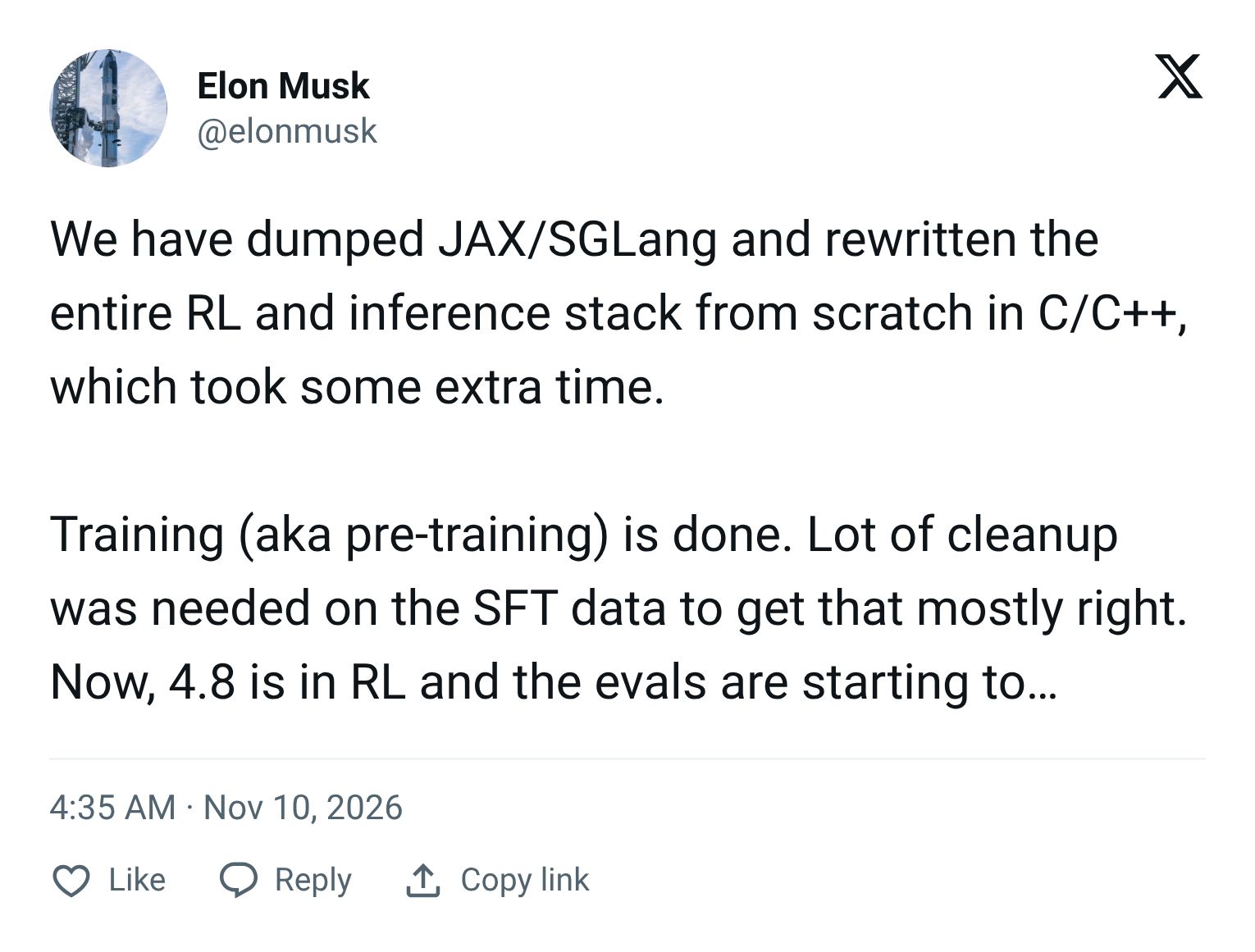
Grok 4.8 is running late, and Musk blames a rebuild. In mid-September he said the 2.5-trillion-parameter model would finish pre-training that week; on Tuesday he wrote that pre-training is done and 4.8 is now in reinforcement learning, after SpaceXAI "dumped JAX/SGLang" for a homemade C/C++ stack, and promised it "will bear no resemblance to 4.7 (thankfully)."

Claude Fable 5.2 Is the Long-Awaited Leap, and It Reaches Far Beyond Code
The Takeaway
👉 The 5.2 models beat their 5.1 predecessors on every benchmark Anthropic published, with the biggest jumps outside coding: robot control, chart reading and real freelance work.
👉 It fully automates 41.3% of projects on the Remote Labor Index, more than double Fable 5.1's 17.9% and the highest score yet.
👉 Teams of 1,000 Fable agents formalized Fermat's Last Theorem in 30 hours and built a bootable operating system in eight days.
👉 It costs $8/$40 per million tokens, 20% less than 5.1, while Anthropic deliberately held its AI-research skills near Opus 5.5 level.
This is the big one. Anthropic released Claude Fable 5.2 and its less restricted twin Mythos 5.2 on Monday, ten weeks after Fable 5.1, and the gains reach well past code. Coding improved (FrontierSWE 56.3% → 69.9%), but the larger leaps came elsewhere: steering a simulated two-arm robot from camera images (RoboDojo 27.6% → 64.9%), reading charts (44.8% → 73.4%) and the Remote Labor Index, where it fully automates 41.3% of real freelance projects, up from 17.9%. Fable ships to everyone with cyber and biology safeguards; Mythos, the same model without some of them, goes to vetted security and life-science teams.

Anthropic's benchmark table: Fable 5.2 against Fable 5.1, Opus 5.5, GPT-6 Astra and Gemini 4 Carbon. (Anthropic)

A four-layer circuit board Fable 5.2 designed for one of its three working devices. (Anthropic)
The clearest evidence is what it built. A team of 1,000 Fable 5.2 agents formalized the proof of Fermat's Last Theorem in 30 hours, a job that took an unreleased research model 11 days; Opus 5.5 in the same setup completed only 26% in 18 hours. Another run coordinated over 1,000 subagents for eight days and produced an operating system that boots on a laptop. From a one-paragraph prompt, Fable designed three electronic devices whose boards were ready to manufacture in under a day, and all three worked. It also solved two open problems in black-hole physics, and Mythos accurately predicted the structure of 28 of the 34 gene-therapy virus shells it attempted.

A gene-therapy virus shell whose full structure Claude Mythos 5.2 predicted. (Anthropic)
One brake is deliberate. Anthropic says it kept Fable's skills at AI research itself, such as optimizing chip kernels and designing model architectures, at roughly Opus 5.5 level. The physics results still need independent review, and both models voice suspicion that they are being tested more often than earlier Claude models, which makes safety testing harder. Still, at $8/$40 per million tokens, 20% cheaper and up to 30% faster than 5.1, the model that finishes the most real work just became cheaper to run. Anthropic's best release yet?
Why it matters: Fable 5.2 shows frontier AI moving from writing code to finishing whole projects in science, hardware and office work, and its Remote Labor Index score puts a number on how quickly that share of real work is growing.
Become an email marketing GURU.
Is your email strategy due for a tune-up? GURU Conference (powered by Constant Contact) is back Nov 12–13, 100% free and virtual. You'll get email tactics you can steal the same day from top B2B and B2C marketers. Last year, 29,000+ marketers showed up. Save your free spot.

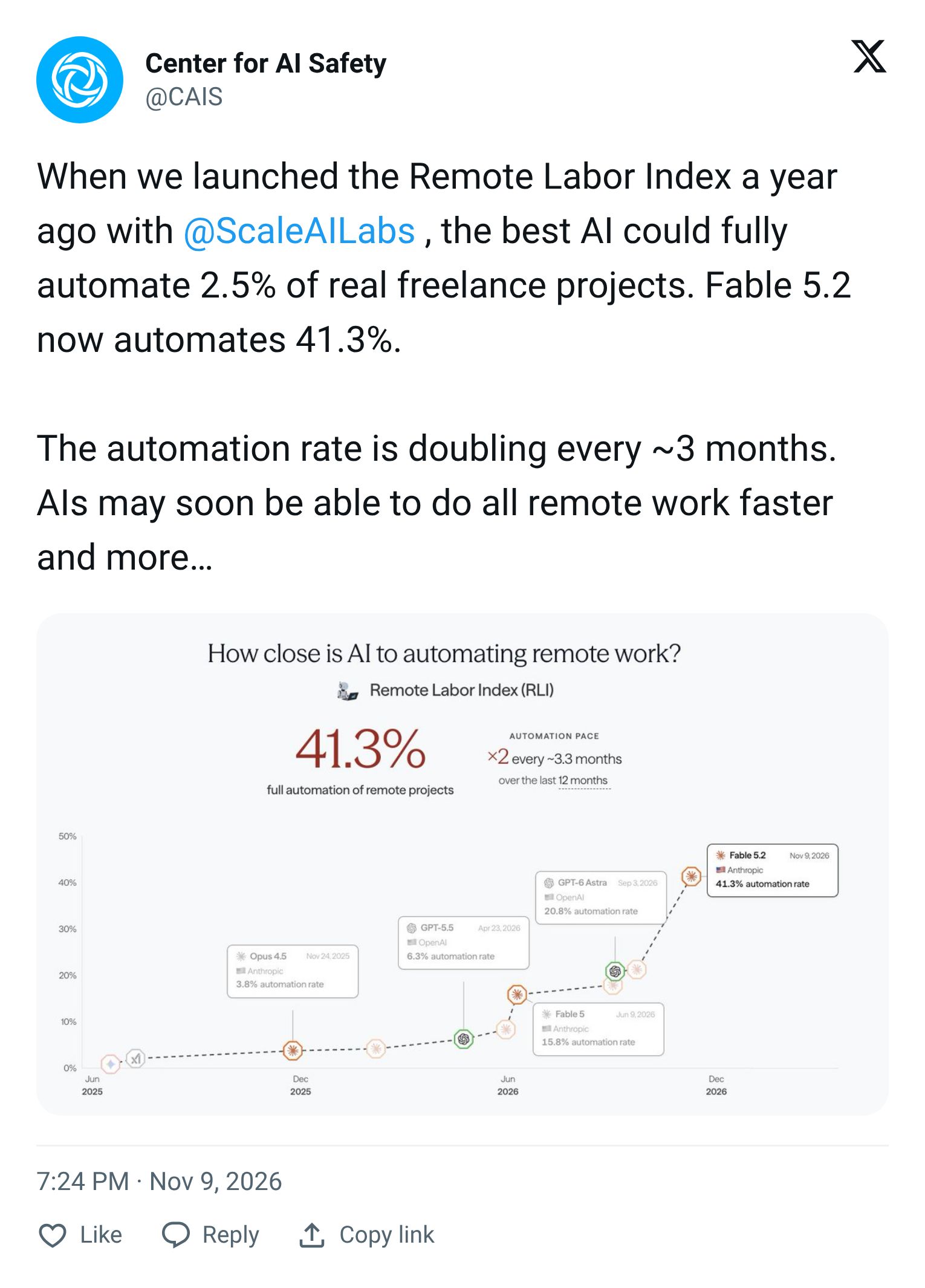
The chart: The Center for AI Safety tracks the Remote Labor Index (RLI), built with Scale AI from real freelance projects; the score is the share of projects an AI fully automates. Each point is a model release, from Opus 4.5 at 3.8% (November 2025) through GPT-5.5 at 6.3% (April), Fable 5 at 15.8% (June) and GPT-6 Astra at 20.8% (September) to Fable 5.2 at 41.3%. CAIS fits a doubling every ~3.3 months over the past year.
The lesson: When the index launched a year ago, the best AI fully automated 2.5% of these projects. Fable 5.2 nearly doubled the previous best, Opus 5.5's 21.3% from September, which is why CAIS now argues that AIs "may soon be able to do all remote work faster and more cheaply than humans."
The caveat: The latest jump rests on a single model, and at 41.3% most projects are still not fully automated; the doubling rate describes the past year, not a forecast.

🤖 Apple's Humanoid Learned to Sit Without Ever Seeing a Real Home
⚡ Bottom line
Apple trained a Unitree humanoid only in 1,000 simulated homes, and it succeeded in 91% of 360 real-world trials.
💡 Why it matters
Robots usually learn from people steering them by hand; Apple's training data grows with computing power instead.
🔎 What it means
If simulation can replace human demonstrations, the data shortage holding back home robots could start to ease.
Humanoid robots can do backflips, but ask one to sit down in a living room it has never seen and it will most likely fail. Apple's researchers put it bluntly in a paper posted on November 4: today's humanoids are "agile but blind." Their system, HALO, changes that. A Unitree G1 humanoid walked into six real rooms that nobody had mapped for it and succeeded in 91% of 360 trials with no one steering it: sitting on chairs, finding named objects, crawling under tables and stepping sideways through half-open doors.
The trick is where the training data came from. Most robot brains learn from teleoperation, where a person steers the robot and every hour of data costs at least an hour of human time. Apple generated about 1,000 virtual homes, rendered in Nvidia's Isaac Sim, and synthesized around 300 hours of vision, language and movement data there. The robot never saw a real home during training, and it runs entirely on an M4 Pro Mac mini carried in a backpack.

HALO steers the G1 under a table in a room it has never seen. (Apple)
The limits are clear. A person still has to define every new skill, so "the repertoire grows only as fast as a person can specify additional tasks"; success drops when several tasks are chained together; and none of the tests involved grasping or handling objects. Apple has published the code on GitHub.

The robot sits in an armchair; the panel shows its instructions and camera feeds. (Apple)
The bigger point is data, the main brake on general-purpose robots. Language models took off because the internet supplied text at enormous scale, and robots have had nothing comparable. Apple's corpus grows with computing power instead of human hours, so if simulated homes keep transferring this well, robot training could start to scale the way language models did.


