
In partnership with


In Today’s Issue:
🚨 The AI 2027 team moves its forecast to 2027
🔐 DeepMind's agents verify Signal's encryption code
📈 Anthropic's IPO is several times oversubscribed
🔓 The Fireworks AI breach reached unfinished models
🏛️ Stanford's AI100 grades its own predictions
✨ And more AI goodness…
⚡ The Signal
The authors of AI 2027 spent much of last year pushing their forecast back. This week they pulled it forward again.
The AI Futures Project now expects a superhuman AI researcher, an AI a lab would rather run on than its best human scientists, some time in 2027, unless the industry deliberately slows down. The trigger is METR's estimate that Anthropic's progress has roughly doubled, mostly thanks to AI itself. The rest of today's issue shows that acceleration from other angles: DeepMind's agents proved key security properties of the code behind Signal's encryption in four weeks, investors want several times more Anthropic stock than is for sale, and Stanford's hundred-year study, after admitting its 2021 panel underestimated scaling, now argues that scaling is running into data and cost limits. Two serious groups, same week, opposite readings of where AI goes next.
All the best,

Kim Isenberg


(Google DeepMind)
🔐 DeepMind's AI Agents Mathematically Verify Signal's Encryption Code
Google DeepMind's AlphaProof Code proved key security properties of the actual compiled code behind the Signal protocol, the encryption that protects billions of chats in Signal and Google Messages. Agents running on Gemini Carbon wrote more than six million lines of proofs in Lean, a language whose checker confirms every step, and flagged only about 1% of the work for human review. The job took four weeks, a task DeepMind says has historically taken expert teams years, and when researchers put two old, already-fixed bugs back in, the system proved those versions insecure.
👉 tl;dr: AI agents can now check that real, deployed security code keeps its promises, making the strongest form of software assurance fast enough to use widely.

(Benzinga)
📈 Anthropic's IPO Draws Orders for Several Times the Shares on Offer
Anthropic has drawn orders for multiple times the stock in its IPO, Bloomberg reports, a day after opening its roadshow at $70 to $78 a share. Together with a $26 billion private placement to Nvidia, Google, Microsoft, TSMC and other partners, the deal could raise up to $90.4 billion, which Bloomberg says would be the largest stock market debut ever. The valuation target of about $1.4 trillion sits below what investors expected a week ago, before AI stocks sold off; pricing is planned for November 18, with trading from November 19.
👉 tl;dr: Investors want far more Anthropic stock than is for sale, putting the Claude maker on track for a record market debut next week.

Fireworks AI CEO Lin Qiao. (Business Insider)
🔓 Fireworks AI Breach Reached Customer Data and Unfinished Models
Fireworks AI, which hosts and fine-tunes AI models for other companies, says an October breach reached customer billing records and, for some accounts, datasets and unfinished model weights, far more than the stored secrets it first disclosed. Attackers used a hacked third-party cloud provider to reach Fireworks' development machines on October 24, and the company links them to "LLMJacking" criminals who resell stolen access to AI models. Two customers told Forbes they have moved much of their business elsewhere; Fireworks says it has found no impact on its inference service.
👉 tl;dr: Hackers got into a company that trains AI models for others and reached some customers' training data and half-built models.


A Single Typo Shouldn’t Cost You a Sale

A shopper types “running shos” and gets nothing back. Another types “red waterprof trail runners under $150” and hits the same wall. Both knew what they wanted.
Traditional site search relies on exact keyword matching, leaving shoppers stranded at “0 results found” screens.
Gladly understands what shoppers mean, typos and all. Instead of a dead end, they get products that fit what they asked for and a conversation that keeps them shopping.

🎬 Watch This
What makes an AI data center worth the money? NVIDIA's Shruti Koparkar, senior product and go-to-market lead for accelerated computing and AI inference, told us it starts with power: each megawatt of an AI factory costs roughly $60 million, so the first thing she would test on any system, NVIDIA's included, is how much work it delivers per megawatt. She explains why programmable software keeps older chips earning, with Pinterest running recommendation, language and vision models on one fleet of about 14,000 GPUs across several generations, and points out that AWS recently raised prices even for six-year-old Ampere GPUs because demand is that strong.

“Get ready to go to jail. Please give your wife a kiss good night.”
– Donald Trump, President of the United States, on 60 Minutes
Trump was explaining why he thinks AI risk "can be managed" by the Justice Department: he says his administration gave this warning to the head of "one of the big" AI companies over "something bad with AI", without naming who or what.

Microsoft is reportedly lobbying the Trump administration to drop a planned ban on Chinese optical transceivers, the parts that move data between servers in AI data centers. Reuters says Microsoft raised supply concerns with officials in September; the House China committee shot back on X that a Pentagon-listed Chinese military company "should not be wiring America's data centers."


AI 2027's Authors: The Intelligence Explosion Is Coming in 2027 After All
The Takeaway
👉 The AI Futures Project, the team behind AI 2027, now expects a superhuman AI researcher in 2027, unless the industry deliberately slows down.
👉 Until now, even its most bullish forecaster, Daniel Kokotajlo, put only even odds on one arriving before 2029.
👉 The trigger: METR estimates Anthropic's progress has roughly doubled, mostly thanks to AI, which the team reads as a 1.7x AI-driven speedup.
👉 The group calls for an industry-wide pause, followed by an international agreement.
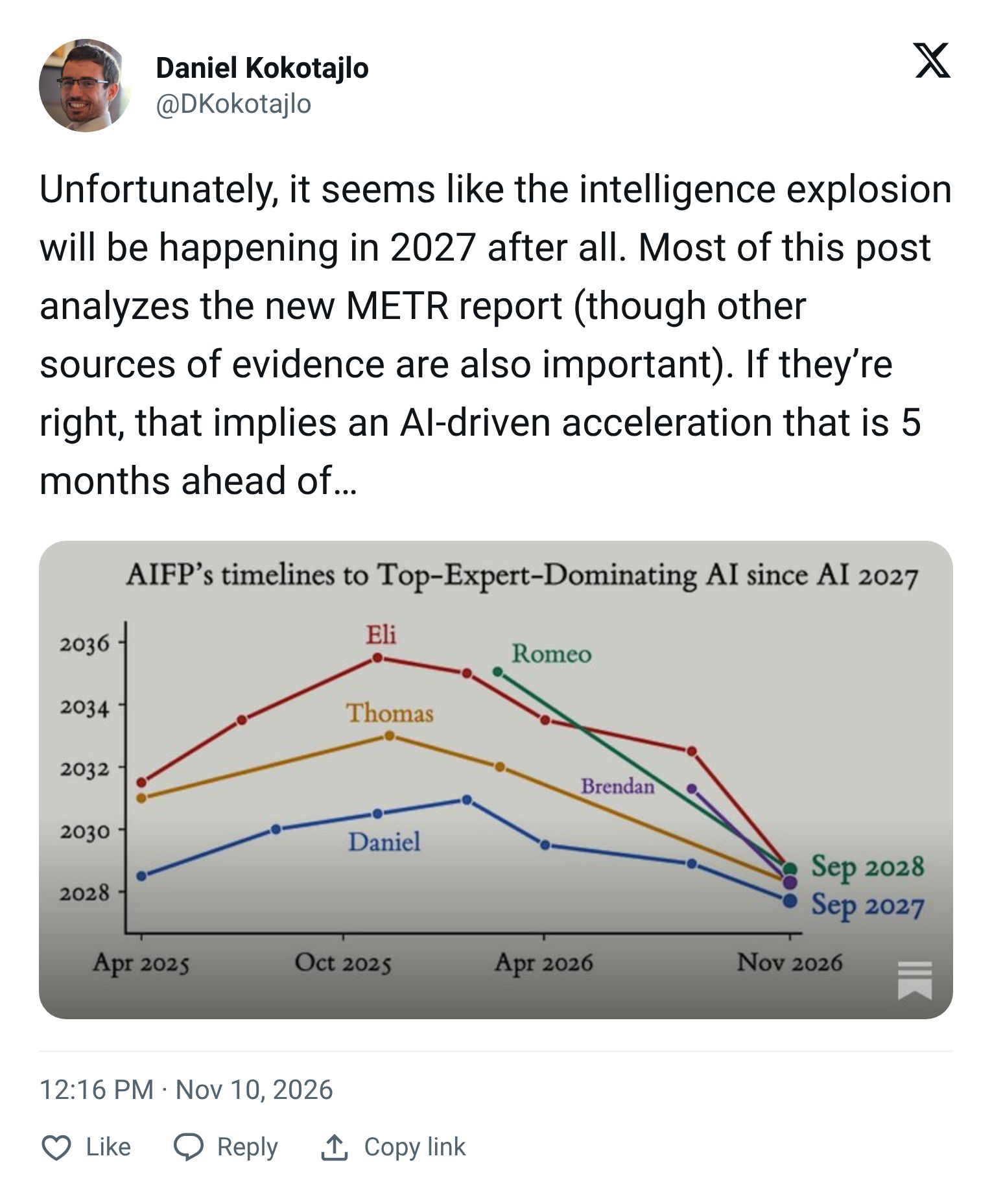
The team behind AI 2027 spent much of last year pushing its forecasts back. Now it has pulled them forward, hard. In a post published Tuesday, the AI Futures Project says all of its forecasters now see a superhuman AI researcher, an AI good enough that a lab would rather run on it alone than on the world's best human researchers without AI, as likely to arrive some time in 2027, assuming no deliberate slowdown. Until now, even its most bullish member, Daniel Kokotajlo, put only even odds on such a system arriving before 2029. The group also sees a 35% to 65% chance that AI able to do all white-collar work arrives before 2028.

Each forecaster's median date for AI that beats top experts at virtually every task: mostly rising through 2025, then falling, with the sharpest drop this month. (AI Futures Project)
The trigger is METR's report on Anthropic, which we covered on Monday. The independent evaluator estimated that Anthropic's AI progress is running at about twice its historical pace, and guessed that roughly 80% of that acceleration comes from AI doing the company's own research work. The forecasters read that as a 1.7x speedup caused by AI, a pace that even the most aggressive version of their model, updated less than three months ago, had given under a 4% chance of reaching by this November. Anthropic redacted most of the evidence METR found most informative, so that figure rests partly on trust.

In the team's picture, AI works like a roughly fivefold stronger engine for research, and because new ideas keep getting harder to find, that becomes 1.7 times faster progress. (AI Futures Project)
The authors are not celebrating. "Unfortunately, it seems like the intelligence explosion will be happening in 2027 after all," Kokotajlo wrote on X. "I am scared, sad, and angry." Their argument: labs are not on track to keep an AI researcher at that level reliably aligned with human goals, and letting a misaligned one build its own successors would put everyone in an extremely bad position. They call for an industry-wide pause, followed by an international agreement.
Why it matters: If the forecasters are right, the point where AI does most of the work of building better AI is roughly a year away, which turns questions about control and regulation from long-term debates into near-term decisions.
Dictation turns "useEffect" into "use effect." Wispr Flow runs on Canto, its own speech model, and reads your personal dictionary, so repo names come out right. 4x faster than typing. Try Wispr Flow free.

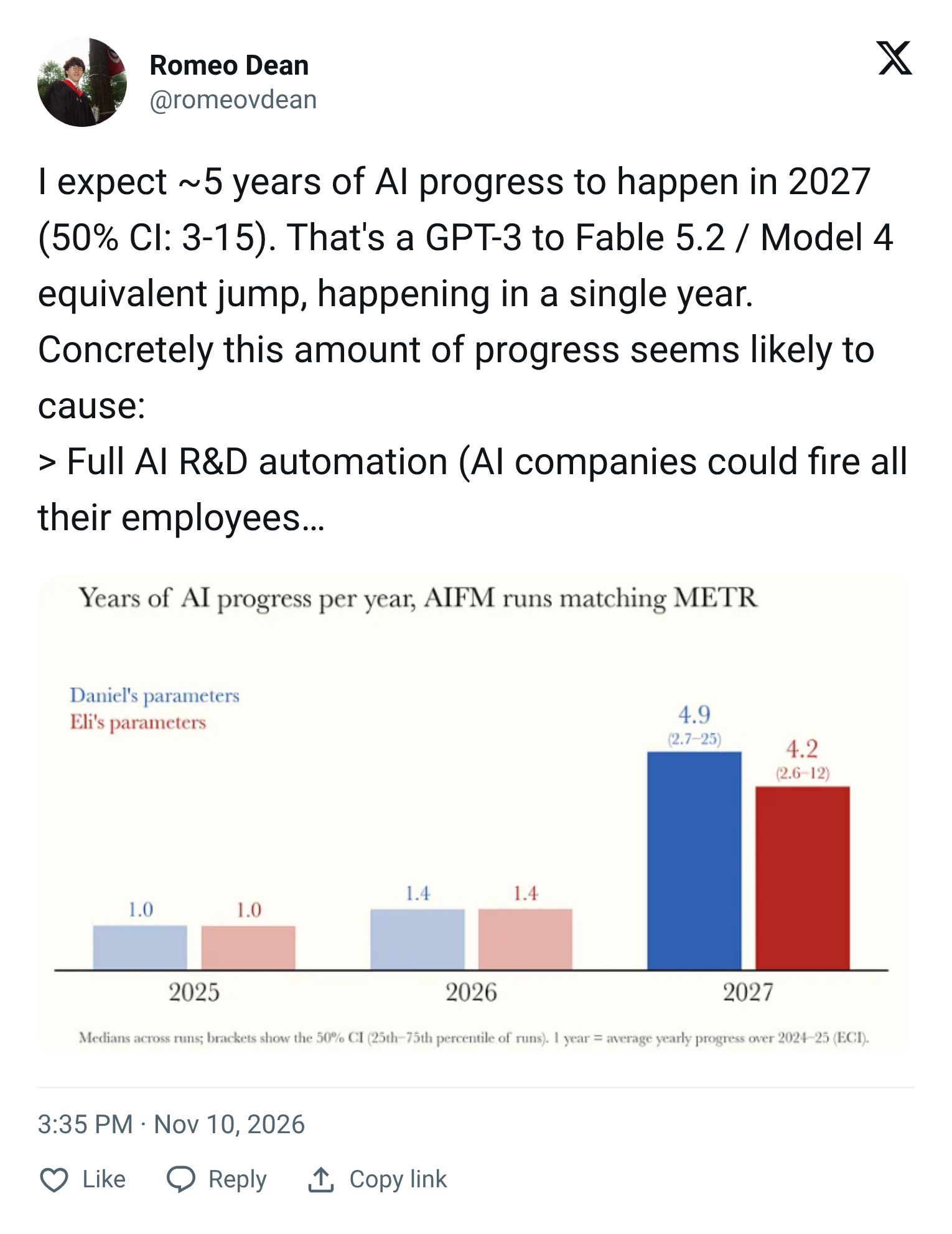
The chart: AI Futures Project researcher Romeo Dean posted the team's model runs that match METR's acceleration estimate, measuring AI progress per calendar year in "years" of the average pace of 2024 and 2025. With Daniel Kokotajlo's settings (blue) and Eli Lifland's (red), 2025 counts as 1.0 year of progress and 2026 as 1.4. Then 2027 jumps to 4.9 and 4.2 years.
The lesson: That last pair of bars is what the team means by an intelligence explosion. Dean calls it "a GPT-3 to Fable 5.2 / Model 4 equivalent jump, happening in a single year" and expects it to bring full automation of AI research at the labs. In the model, 2026 is only modestly faster; the jump comes in 2027, the year the team now expects AI researchers to overtake human ones.
The caveat: These are medians, and the spread is wide: the middle half of runs ranges from 2.6 to 25 years of progress in 2027.

🔭 Stanford's 100-Year AI Study Admits It Got 2021 Wrong
⚡ Bottom line
Stanford's AI100 report says its 2021 panel underestimated how far scaling up language models would go.
💡 Why it matters
The same study now argues scaling is hitting data and cost limits, while warning that insiders often misjudge what comes next.
🔎 What it means
The next gains may come from reasoning, memory and agents, and AI still has to prove it pays for itself.
Every five years, Stanford's One Hundred Year Study on AI (AI100) asks a panel of experts to take stock of the field. This time the panel started by grading its predecessors. The third report came out on Tuesday, and its look back at 2021 is blunt: that panel suspected deep learning's dominance "may be coming to an end", doubted AI could gain common sense without a body, and did not foresee a chat window reaching 100 million users within 14 months.

The 2026 report, "AI Goes Mainstream: The Scaling Era and the Rise of Generative AI." (Stanford AI100 via TNW)
The diagnosis: the 2021 experts, nearly all insiders, underestimated what happens when you keep scaling the same architecture. Since then, frontier models have reached or neared expert level on bar and medical exams, and AI has proved open problems in mathematics, alone or with humans. In 2026, the report notes, Claude Fable found a one-line counterexample that disproves the famous Jacobian conjecture in three or more dimensions.
Now the panel makes its own big call: scaling is running into limits. Fresh high-quality data is scarce and frontier training runs cost too much, so it expects the next gains to come from smarter algorithms, longer reasoning, memory and agents rather than ever bigger models. It also warns that the data center boom has outpaced earlier investment booms while AI "is not yet paying its way" in economic data or company returns.

Geoffrey Hinton and John Hopfield at the 2024 Nobel lectures; the report cites their Nobel as recognition of how fast AI is transforming science. (Stanford AI100)
The report also turns that lesson on itself: when the field's leading insiders agree on what comes next, "they may be converging on the previous paradigm's limits, not on the next paradigm's trajectory." Read next to today's AI 2027 update, that is the live debate in one sentence. And the report's own boldest forecast is an optimistic one: within a decade, it expects AI-powered labs to be the norm across every scientific discipline.


